Una página de Social reúne tres imágenes de mujeres y una noticia breve sobre Armando Maribona. El texto enlaza una exposición que se celebra en el Lyceum habanero con un viaje próximo a Centroamérica. La página, conservada en una copia que la identifica como parte del volumen 18, número 7, de julio de 1933, permite observar cómo un artista preparaba su presencia pública antes de desplazarse. La presentación de imágenes femeninas, sus pies sociales y el anuncio de una pequeña selección viajera enlazan la actividad artística con la vida de la revista. [1]
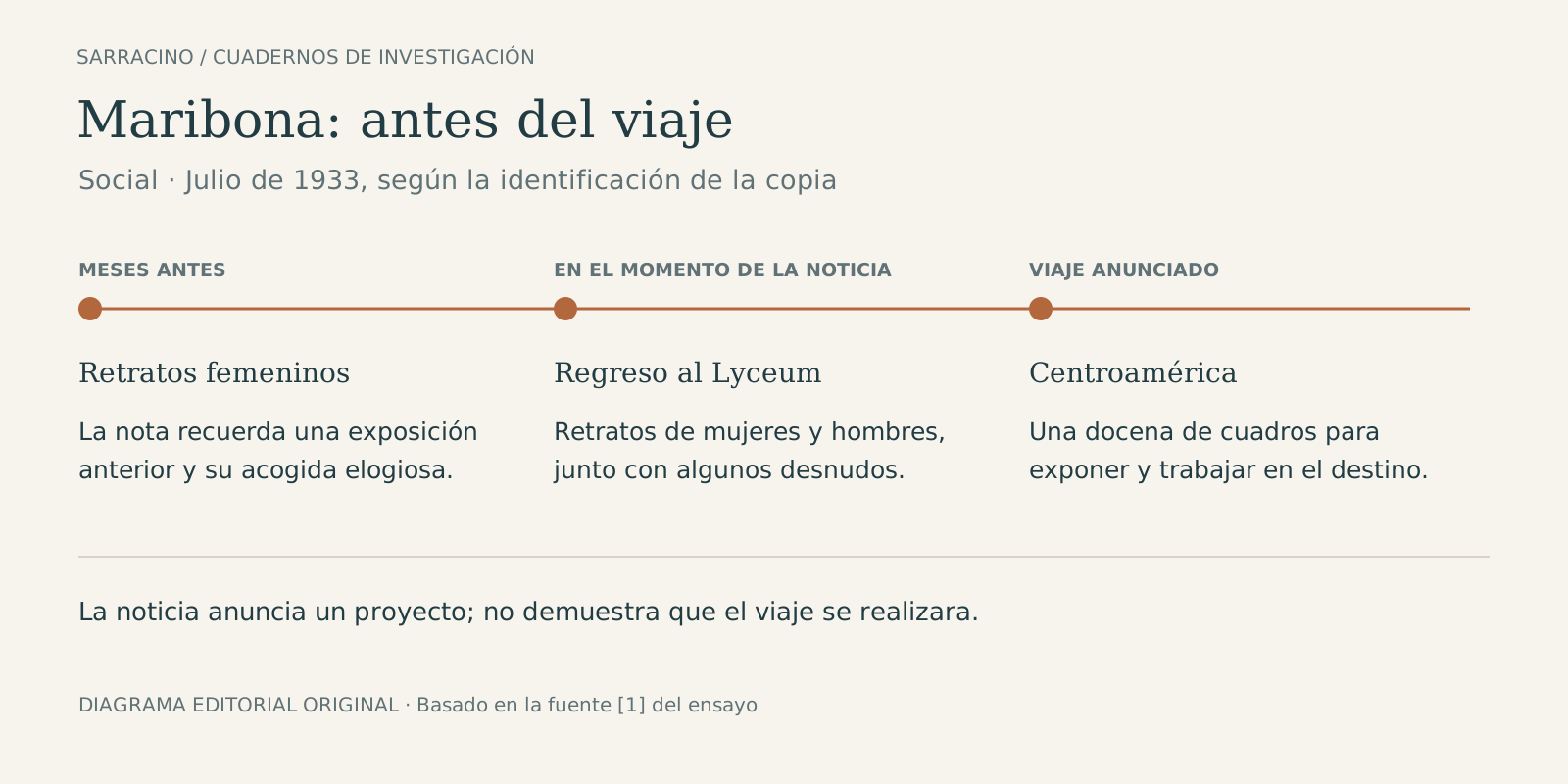
La noticia comienza recordando los elogios obtenidos meses antes por una exposición de retratos femeninos. Maribona vuelve ahora a los mismos salones con retratos de mujeres y hombres y algunos desnudos. Esa continuidad importa: el Lyceum aparece como un lugar al que se regresa, donde la obra reciente puede medirse con una presentación anterior y donde un público ya familiarizado con el artista recibe nuevas razones para seguirlo. El anuncio construye una secuencia profesional, aunque no ofrece fechas de apertura, lista completa de obras ni resultados comerciales.
Mujeres con nombre y ocupación
Las tres reproducciones no reciben el mismo tratamiento. La figura de la parte superior lleva el pie genérico Desnudo. Las dos restantes tienen nombres y una breve identificación social. Marisabel Saenz aparece como redactora de cultura física de la propia revista y futura conferenciante sobre estética y biología femeninas. Rosie Galiano de Girón es presentada como esposa del cónsul general de Guatemala en Cuba. Junto a los retratos figura además el crédito «Van Dyck», cuya función exacta deberá aclararse. La proximidad al anuncio de Maribona no demuestra que esas dos imágenes reproduzcan pinturas suyas. Mantener sus pies permite observar cómo la página reúne un tema artístico, una colaboradora profesional y un vínculo de representación social.
En el retrato de Saenz, el rostro se eleva y se vuelve lateralmente. El cabello ondulado, los ojos destacados y la boca bien definida concentran la atención. El texto que acompaña la imagen introduce, sin embargo, otra dimensión. Quien mira no recibe únicamente la efigie de una mujer elegante; encuentra el anuncio de una actividad intelectual y pedagógica. La página contribuye a difundir la labor de una colaboradora al mismo tiempo que anuncia la actividad de Maribona. No se ha establecido la autoría ni el medio de este retrato; su presencia sí permite reconocer la convivencia de ambas promociones en una misma página.
El retrato de Rosie Galiano de Girón adopta una presencia más frontal. Una mano visible y el apoyo del cuerpo organizan la relación con el espectador. Su identificación consular pone a Guatemala dentro de la página antes de que el párrafo anuncie Centroamérica. La coincidencia es sugerente: el mundo social representado y el horizonte geográfico del viaje se tocan. No demuestra que la familia Girón organizara una exposición, financiara el traslado o recibiera al artista. Sí muestra que la región anunciada no era, para los lectores de Social, una abstracción enteramente separada de la vida habanera.
Un desnudo junto a los retratos
La figura desnuda ocupa un espacio amplio en el sector superior. Está sentada y el cuerpo se abre mediante diagonales: la inclinación de una pierna, el brazo que desciende y el brazo que sostiene la postura. La cabeza conserva un peinado contemporáneo, sin que la imagen necesite una identificación mitológica. La vecindad de los retratos inserta ese estudio corporal en el mismo universo visual de mujeres reconocibles y arreglos modernos. La combinación hace convivir distintas maneras de presentar a una mujer: el estudio de figura, el retrato identificado por su labor y la imagen asociada a una relación diplomática.
La reproducción impresa impone sus propias condiciones. La trama de medios tonos permite distinguir contornos, zonas oscuras y distribución de las luces, pero aplana matices y no establece por sí sola el medio original de cada imagen. Conviene por eso atender a la composición editorial y mantener abierta la identificación de sus componentes. Tres imágenes femeninas conviven con un anuncio de retratos de ambos sexos. La selección de la revista no equivale al inventario del salón ni permite incorporar los dos retratos sociales a una lista de cuadros expuestos.
El Lyceum añade otra capa a esta relación entre arte y presencia femenina. Luz Merino Acosta recuerda que la asociación se constituyó en diciembre de 1928 y se abrió públicamente en febrero de 1929, promovida por mujeres y orientada a actividades educativas y culturales. Su estudio sitúa las exposiciones dentro de ese programa amplio. Este contexto permite entender que el lugar mencionado por Social ofrecía una mediación activa entre artistas y públicos. No corresponde reducirlo a una dirección prestigiosa que el anuncio utiliza como aval. [2]
La obra viaja primero como noticia
El párrafo final promete que Maribona partirá con una docena de sus mejores cuadros para exponer y trabajar. La fórmula presenta al artista en movimiento y propone una escala manejable: una selección, no un traslado indiscriminado del taller. También reúne dos actividades distintas. Exponer significa llevar una producción ya realizada; trabajar abre la posibilidad de hacer obra nueva en el destino. La breve noticia proyecta así una carrera que se prolonga más allá de la muestra habanera.
Su tono es abiertamente cercano. La revista identifica a Maribona como amigo y colaborador, celebra sus méritos y le desea triunfos. Este vínculo no invalida la información, pero aclara su función: la nota participa en el lanzamiento del viaje y en la construcción de una reputación. Sus elogios son testimonios de esa acogida, no una valoración independiente del conjunto expuesto.
El interés histórico de la página se encuentra precisamente en esa anticipación. Antes de contar con una exposición centroamericana documentada, contamos con una imagen pública preparada para ella: la promesa de cuadros escogidos, un lugar de presentación en La Habana y una revista que sitúa la noticia junto a mujeres identificables de su mundo social. El futuro verbal debe conservarse. No sabemos por esta noticia si Maribona llegó a viajar ni dónde expuso después. Sí sabemos que, en julio de 1933 según la identificación de la copia, la circulación pública de su proyecto había empezado ya en el papel.
Diagrama editorial original de la secuencia anunciada en Social: una exposición anterior de retratos femeninos, el regreso al Lyceum y un viaje proyectado a Centroamérica con una docena de cuadros. Julio de 1933 según la identificación de la copia. Basado en [1]; no acredita que el viaje se realizara. La página de archivo analizada en el ensayo no se reproduce en esta edición.
Fuentes y referencias
[1] Autor no indicado. Retratos y desnudos de Maribona, Social. Julio de 1933, vol. 18, n.º 7 según encabezado de la copia. PDF C13 p. 1; página impresa sin número visible. Recorte reproducido con encabezado recompuesto; cotejo visual realizado. Archivo Sarracino, documento C13.
[2] Luz Merino Acosta. El Lyceum y Lawn Tennis Club y las artes plásticas cubanas, Espacio Laical. 2018, n.º 4. pp. 53-61; contexto utilizado pp. 53-54. Estudio secundario con referencias a acta fundacional y testimonios históricos. Fuente en línea
[3] Florida International University / Digital Library of the Caribbean. Colección Social. 1916-1938. Colección, no número de julio 1933 consultado. Repositorio primario identificado; número completo pendiente de cotejo. Fuente en línea
A page from Social brings together three images of women and a short notice about Armando Maribona. Its text connects an exhibition taking place at Havana’s Lyceum with a forthcoming journey to Central America. Preserved in a copy identifying it as part of volume 18, number 7, July 1933, the page reveals how an artist could prepare his public presence before leaving home. Female images, their social captions and the announcement of a small travelling selection connect artistic activity with the life of the magazine. [1]
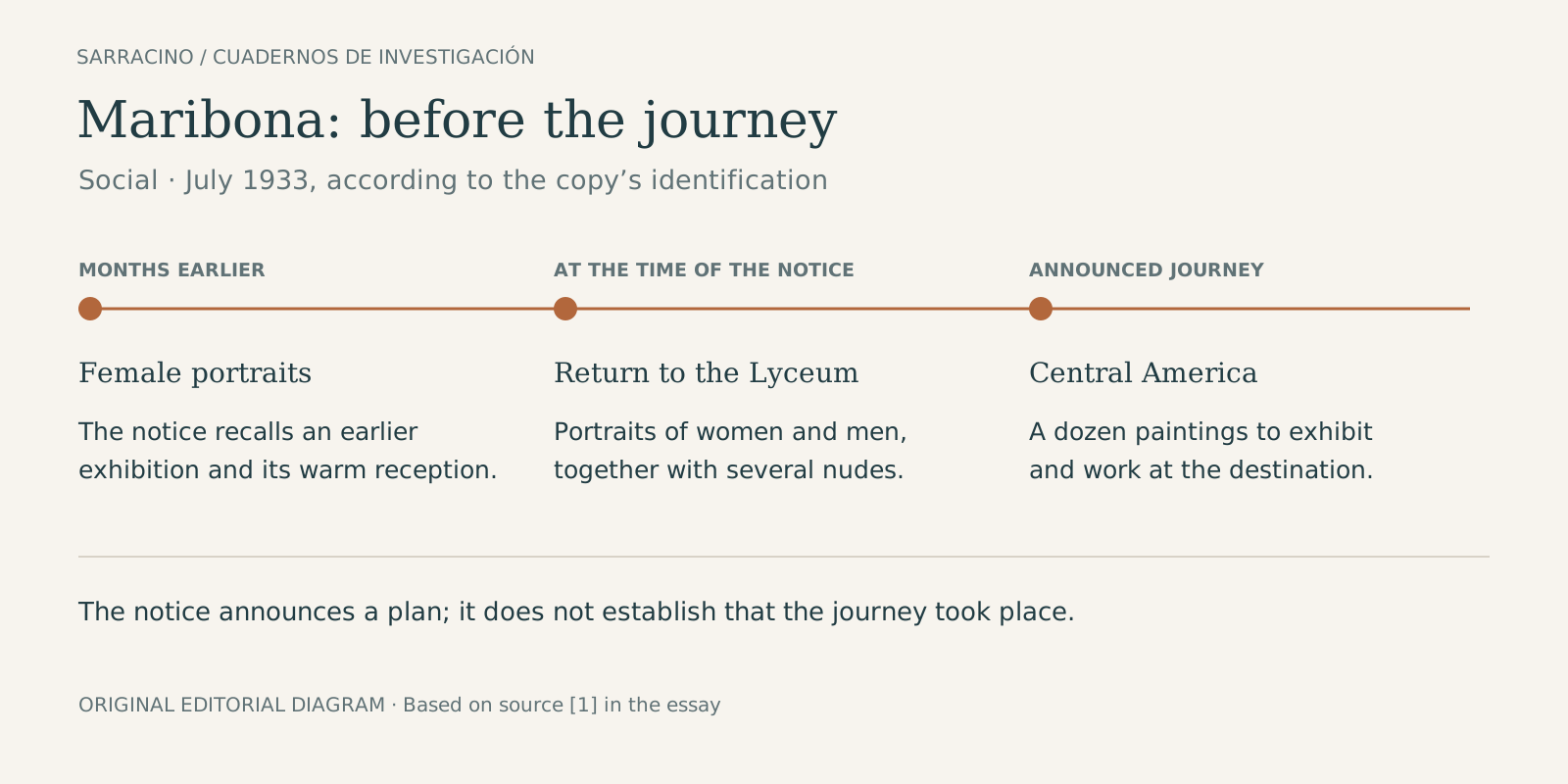
The notice opens by recalling the praise received several months earlier by an exhibition of female portraits. Maribona now returns to the same rooms with portraits of women and men and several nudes. This continuity matters. The Lyceum emerges as a place to return to, where recent work can be considered alongside a previous presentation and where viewers already familiar with the artist find new reasons to follow him. The announcement constructs a professional sequence, although it provides neither opening dates nor a complete checklist or sales figures.
Women with names and occupations
The three reproductions are treated differently. The figure at the top receives the generic caption Nude. The other two have names and brief social identifications. Marisabel Saenz is introduced as the magazine’s physical-culture writer and a forthcoming lecturer on women’s aesthetics and biology. Rosie Galiano de Girón is presented as the wife of Guatemala’s consul general in Cuba. The credit “Van Dyck” also appears beside the portraits; its precise function remains to be established. Proximity to the Maribona announcement does not establish that these two pictures reproduce paintings by him. Preserving the captions reveals how the page brings together an artistic subject, a professional contributor and a link within a social network.
In Saenz’s portrait, her face tilts upward and turns to the side. Wavy hair, strongly marked eyes and a clearly defined mouth focus the viewer’s attention. Yet the accompanying text introduces another dimension. The reader encounters more than an elegant woman’s likeness: an intellectual and educational activity is also announced. The page publicizes a contributor’s work while announcing Maribona’s activities. The portrait’s authorship and medium have not been established, but its presence does reveal the coexistence of both kinds of promotion on a single page.
The portrait of Rosie Galiano de Girón establishes a more frontal presence. A visible hand and the support beneath the body help organize her relation to the viewer. Her consular identification brings Guatemala onto the page before the paragraph announces Central America. The coincidence is suggestive: the social world represented and the journey’s geographical horizon meet. It does not prove that the Girón family organized an exhibition, financed the passage or hosted the artist. It does show that the region evoked was not entirely detached from Havana life for Social’s readers.
A nude beside the portraits
The nude occupies a large area of the upper section. The seated body opens through diagonals: the angle of a leg, a descending arm and the arm supporting the pose. The figure has a contemporary hairstyle and requires no mythological identification. Its proximity to the portraits places this study of the body within the same visual world of recognizable women and modern appearances. The combination brings together different ways of presenting a woman: a figure study, a portrait identified through professional activity and an image associated with a diplomatic connection.
Printed reproduction imposes conditions of its own. The halftone screen allows us to distinguish contours, dark areas and the distribution of light, but it flattens nuances and does not establish each image’s original medium. Attention should therefore remain on the editorial composition while the identification of its components stays open. Three female images coexist with an announcement of portraits of both sexes. The magazine’s selection is not the exhibition’s inventory, and it does not justify adding the two society portraits to a list of exhibited paintings.
The Lyceum adds a further dimension to this connection between art and women’s public presence. Luz Merino Acosta recalls that the association was established in December 1928 and opened to the public in February 1929. Founded by women, it pursued educational and cultural activities, with exhibitions forming part of this wider programme. Her account helps us understand that the venue mentioned by Social actively connected artists and audiences. It should not be reduced to a prestigious address lending authority to an announcement. [2]
The work travels first as news
The final paragraph promises that Maribona will leave with a dozen of his best paintings to exhibit and work. This wording presents an artist in motion and proposes a manageable scale: a selection rather than the wholesale transfer of a studio. It also brings together two distinct activities. Exhibiting means taking work already made; working leaves open the possibility of producing new paintings at the destination. The short notice thus projects a career extending beyond the Havana exhibition.
Its tone is openly friendly. The magazine identifies Maribona as a friend and contributor, celebrates his merits and wishes him success. This connection does not invalidate the information, but it clarifies its purpose. The notice participates in launching the journey and building a reputation. Its praise records that support rather than supplying an independent assessment of the entire exhibition.
The page’s historical interest lies precisely in this anticipation. Before we possess documentation of a Central American exhibition, we have a public image prepared for one: the promise of selected paintings, a Havana venue and a magazine placing the announcement alongside identifiable women from its social world. The future tense must remain intact. This notice does not establish whether Maribona actually travelled or where he subsequently exhibited. It does establish that, in July 1933 according to the copy’s identification, his project had already begun to circulate publicly on paper.
Original editorial diagram of the sequence announced in Social: an earlier exhibition of female portraits, a return to the Lyceum and a proposed journey to Central America with a dozen paintings. July 1933 according to the copy’s identification. Based on [1]; it does not establish that the journey took place. The archival page analysed in the essay is not reproduced in this edition.
Sources and references
[1] Unidentified author. Retratos y desnudos de Maribona, Social. July 1933, vol. 18, no. 7, according to the heading of the copy. C13 PDF, p. 1; original printed page number not visible. Reproduced clipping with a re-typeset heading; visually checked. Sarracino archive, document C13.
[2] Luz Merino Acosta. El Lyceum y Lawn Tennis Club y las artes plásticas cubanas, Espacio Laical. 2018, no. 4. pp. 53-61; context used on pp. 53-54. Secondary study citing founding records and historical testimonies. Online source
[3] Florida International University / Digital Library of the Caribbean. Colección Social. 1916-1938. Collection-level record; the complete July 1933 issue was not consulted. Primary repository identified; the issue remains to be checked. Online source
Los enlaces externos se abren en otra pestaña. Para volver, cierra esa pestaña o selecciona la de Sarracino Gallery.External links open in a new tab. To return, close that tab or select the Sarracino Gallery tab.