Sarracino Art Research & Advisory

Antes de vender una obra de arte

Examen de condición y estudios técnicos para una decisión informada
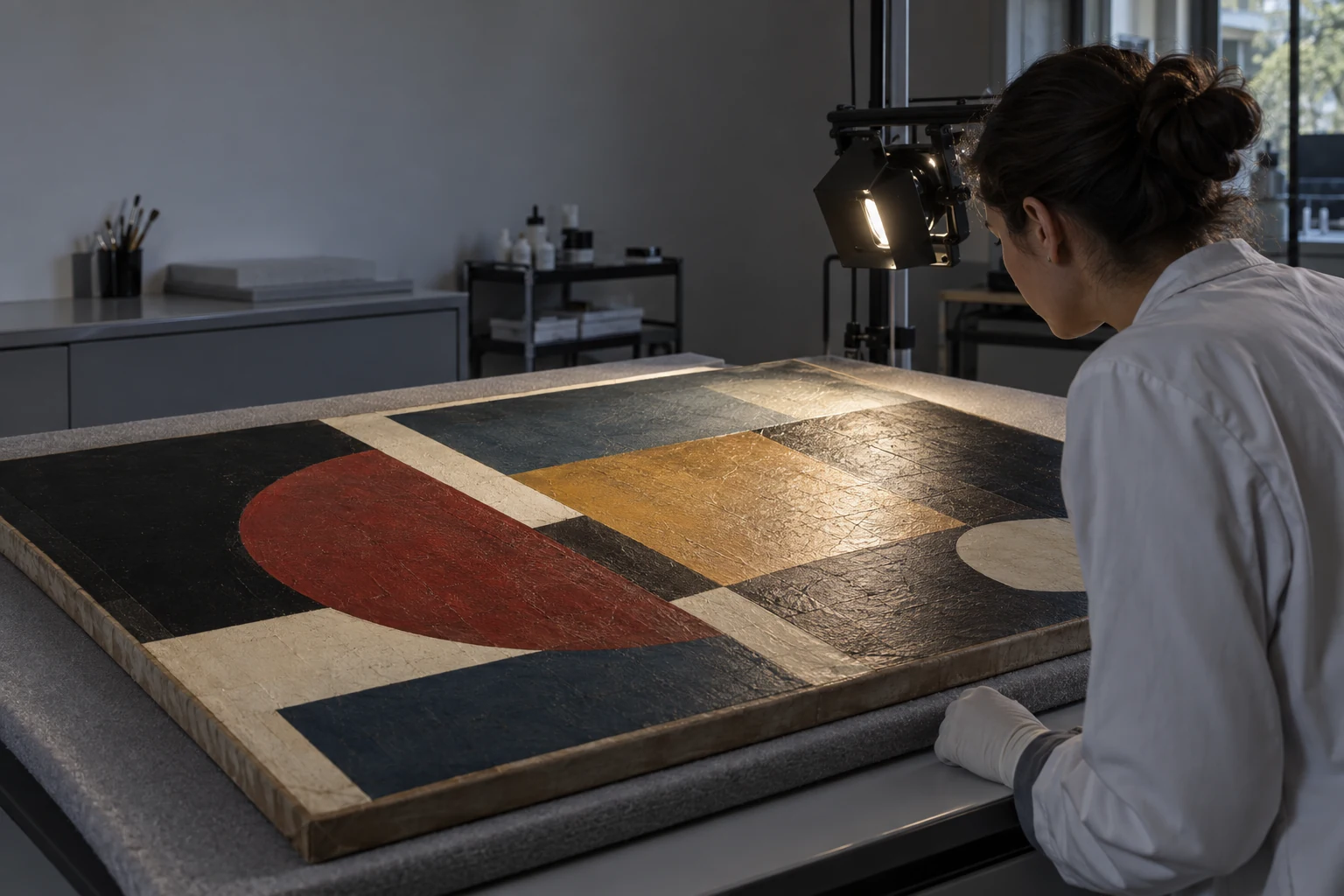
Examen de una pintura bajo luz rasante. Imagen ilustrativa creada para este artículo; no representa una obra ni un estudio específico.

Una pintura puede parecer impecable cuando está colgada y contar una historia diferente bajo luz rasante, ultravioleta o al examinar su reverso. Un desgarro reparado, un reentelado, pintura levantada, un barniz alterado o extensos retoques pueden pasar casi inadvertidos en una fotografía convencional.

Esa información no convierte automáticamente una obra en buena o mala. Tampoco determina por sí sola su autenticidad o su precio. Lo que hace es reducir incertidumbre, permitir una negociación más clara y ayudar a decidir si la obra está estable, si necesita tratamiento y si su estado material es coherente con la operación propuesta.

El instrumento central es el condition report o informe de condición: un registro profesional, fechado y normalmente ilustrado, del estado físico de la obra y de su marco en el momento del examen. Bien preparado, funciona como una línea de base para una venta, compra, préstamo, transporte, seguro o reclamación. [1]

Cuatro preguntas relacionadas y cuatro tipos de evidencia
ESTADO FÍSICOQué daños, cambios e intervenciones presenta
AUTENTICIDADQuién pudo realizarla y qué autoridad puede pronunciarse
PROCEDENCIACómo se documenta su historia de propiedad
VALORACIÓNQué indica el mercado para una fecha y propósito concretos

Estado físico autenticidad procedencia y valor

Estas cuatro preguntas se relacionan, pero no son intercambiables. El informe de condición describe la materialidad y la estabilidad de la obra. La autenticación atribuye autoría mediante autoridad competente y evidencia histórica, estilística o científica. La procedencia reconstruye la cadena de propiedad y circulación. La valoración estima un valor para una fecha, mercado y propósito determinados.

Un conservador puede encontrar materiales, reparaciones o características compatibles o incompatibles con una hipótesis histórica. Los estudios técnicos pueden aportar evidencia relevante para una atribución. Aun así, el conservador no se convierte automáticamente en autenticador ni en tasador. La National Gallery of Art emplea luz visible y ultravioleta, microscopía, radiografía e infrarrojo para comprender materiales, proceso creativo, condición y posibles problemas de atribución; la conclusión exige integrar esos resultados con otras pruebas. [3]

La separación de funciones protege al comprador y al vendedor. Un informe material independiente gana credibilidad cuando no promete certificar autoría ni fijar un precio. Una venta sólida reúne, según el caso, condición, autoridad de autenticación, procedencia y evidencia de mercado.

Qué aporta a una venta

Para el vendedor, un examen previo permite conocer los problemas antes de que aparezcan durante la negociación. Puede revelar si el lienzo conserva su soporte original, si fue reentelado, si existen parches, pérdidas, deformaciones, craqueladuras activas, abrasiones, zonas repintadas o un barniz que modifica los colores.

Para el comprador, el informe permite comparar el precio con el estado real y estimar riesgos futuros: estabilidad, transporte, seguro y posible tratamiento. Para una casa de subastas o aseguradora, ofrece documentación ordenada y un punto de referencia fechado.

Un condition report no garantiza un precio mayor. Puede incluso revelar problemas que obliguen a revisar el estimado. Su aportación más importante es que reduce aquello que las partes desconocen y disminuye la posibilidad de conflictos posteriores.

Qué es un análisis organoléptico

El término suena más complejo de lo que es. En conservación, el análisis organoléptico es la primera lectura sistemática de las propiedades perceptibles de la obra antes de recurrir a pruebas de laboratorio. Es principalmente visual, apoyado por aumento, iluminación controlada y examen del frente, reverso, bordes, bastidor y marco. El contacto físico se limita a lo estrictamente necesario y lo realiza una persona capacitada.

El conservador observa soporte, preparación, capa pictórica y superficie. Registra craqueladuras, deformaciones, pérdidas, levantamientos, abrasiones, manchas, depósitos, cambios del barniz, reparaciones, parches, costuras, reentelados, inscripciones, etiquetas y elementos del montaje. También distingue entre daño, envejecimiento natural y decisiones originales del artista.

Mirar una obra de forma profesional es un procedimiento, no una impresión rápida. El Canadian Conservation Institute recomienda revisar informes anteriores, evaluar primero la estabilidad para manipularla con seguridad y documentar de manera sistemática cada componente. [1][2]

La luz como instrumento de examen

La luz normal permite evaluar el aspecto general, la suciedad, el barniz, las pérdidas y la pintura levantada. La luz rasante se coloca en un ángulo bajo y hace visibles ondulaciones, golpes, relieve, irregularidades y deformaciones que desaparecen bajo iluminación frontal. La luz transmitida, colocada detrás de ciertos lienzos, ayuda a localizar perforaciones, grietas y variaciones de espesor. [2]

La radiación ultravioleta puede hacer que barnices, retoques y otros materiales respondan de manera diferente. Es útil para localizar patrones, pero una mancha oscura bajo UV no constituye por sí sola una prueba de restauración o falsificación. El resultado depende de materiales, edad, capas y tratamientos previos.

El infrarrojo puede revelar dibujos preparatorios, inscripciones o modificaciones, según los pigmentos y materiales. La radiografía ofrece otra profundidad estructural. Ninguna modalidad responde todas las preguntas; su valor surge al combinar observación, imágenes y contexto.

Del ojo al laboratorio

Las pruebas científicas deben seleccionarse después de formular una pregunta. Solicitar muchas técnicas sin un objetivo claro aumenta el costo sin garantizar una respuesta útil. XRF puede detectar elementos químicos relacionados con pigmentos; no identifica automáticamente una marca, una receta o una fecha exacta. La microscopía de secciones transversales estudia la sucesión de capas. FTIR y Raman pueden caracterizar aglutinantes, pigmentos y otros compuestos. Algunas configuraciones son no invasivas; otras exigen micro-muestras y autorización expresa. [3][9][12]

MétodoQué puede aportarLímite principalAlcance
Observación directa y aumentoCraqueladuras, pérdidas, levantamientos, abrasiones, suciedad, reparaciones, etiquetas y estructura visible.Depende de la experiencia y no identifica por sí sola la composición química.No invasiva y básica
Luz rasante y transmitidaDeformaciones, ondulaciones, relieve, perforaciones, grietas y diferencias de espesor.La luz transmitida no es útil en todos los soportes ni en todas las capas pictóricas.No invasiva y básica
UltravioletaPatrones de fluorescencia en barnices y posibles retoques o reintegraciones.Una zona oscura no prueba por sí sola restauración ni falsedad; requiere interpretación.No invasiva y adicional
InfrarrojoDibujos preparatorios, inscripciones y algunos cambios de composición.No todos los pigmentos ni materiales dejan ver las capas inferiores.No invasiva y especializada
RadiografíaEstructura, clavos, daños, cambios de composición y diferencias asociadas a ciertos pigmentos.Requiere equipo, medidas de seguridad e interpretación especializada.Especializada
XRFElementos químicos que orientan la identificación de pigmentos y materiales.Detecta elementos, no entrega automáticamente un pigmento, fabricante o fecha exacta.Normalmente no invasiva
Microscopía FTIR y RamanEstratigrafía, fibras, pigmentos, aglutinantes y materiales orgánicos o inorgánicos.Puede requerir micro-muestras y debe responder una pregunta concreta.Avanzada y cotizada aparte

Qué debe contener un informe profesional

Un informe útil identifica la obra y el propósito del examen. Debe registrar artista o atribución, título, técnica, soporte, medidas, firma, fecha e inscripciones cuando existan; describir frente, reverso, bastidor y marco; y documentar preparación, capa pictórica, barniz, deformaciones, pérdidas, craqueladuras, reparaciones e intervenciones visibles.

También debe indicar estabilidad, riesgos, recomendaciones de manipulación, exposición, almacenamiento o tratamiento, nombre y credenciales del examinador, fecha, alcance y limitaciones. Las fotografías generales del frente y reverso, junto con detalles de las zonas relevantes, convierten el informe en una línea de base que puede compararse con inspecciones futuras. [1]

Para una venta importante conviene pedir un informe firmado y preguntar si puede entregarse a un comprador, casa de subastas, aseguradora o abogado. Debe quedar claro qué técnicas están incluidas, si la obra será desenmarcada, si habrá UV o luz rasante y si las imágenes forman parte del documento final.

Qué sucede en una casa de subastas

Cuando una obra es aceptada en consignación por una de las principales casas internacionales o por una firma especializada, comienza un proceso de examen, investigación, catalogación y presentación. El alcance varía según la casa, la categoría y la importancia del lote. Los especialistas revisan técnica, dimensiones, soporte, firmas, inscripciones, etiquetas, procedencia, bibliografía, exposiciones y condición, y esa información influye en la descripción, el estimado y la forma de presentar la obra.

Christie's, Sotheby's, Phillips, Bonhams y LAMA facilitan información de condición con modalidades diferentes. Sin embargo, el informe de una casa de subastas no equivale necesariamente a un estudio exhaustivo realizado por un conservador independiente. Phillips lo expresa con especial claridad: sus especialistas no son restauradores profesionales ni conservadores formados y recomienda contratar asesor propio para obras de valor significativo. [14][17]

Christie's

Evalúa condición, procedencia, rareza y mercado; después de la consignación cataloga y fotografía profesionalmente. Sus condition reports son gratuitos y orientativos; recomienda inspección personal. [14][15]

Sotheby's

Indica que toda obra que va a subasta se fotografía profesionalmente para documentación y promoción. La información de condición y la exhibición previa ayudan al comprador a examinar el lote. [16]

Phillips

Sus especialistas pueden preparar condition reports, pero la propia guía aclara que no son restauradores ni conservadores formados y recomienda asesor independiente para lotes de valor significativo. [17]

Bonhams

Permite solicitar condition reports para numerosos lotes y presenta fotografías de catálogo. La disponibilidad y el alcance deben confirmarse en la página de cada lote. [18]

LAMA

LA Modern Auctions, dentro de la estructura Rago/Wright/LAMA, pone información de condición a disposición antes de la venta y acompaña los lotes con documentación fotográfica. El alcance depende de la venta y del objeto. [19]

Fotografía, limpieza y límites de la información

La fotografía profesional forma parte de la debida diligencia de mercado. Christie's describe la catalogación y fotografía profesional después de la consignación; Sotheby's afirma que cada obra que va a subasta se fotografía para fines documentales y promocionales. Las imágenes pueden mostrar frente, reverso, firma, etiquetas y detalles, algo esencial cuando el comprador se encuentra lejos. [15][16]

La limpieza o restauración previa no es automática. En algunos casos una casa puede coordinar una consulta o un tratamiento autorizado por el propietario cuando mejora la estabilidad o la presentación responsable. No debería limpiarse una obra simplemente para que parezca más atractiva. Una limpieza excesiva puede eliminar veladuras, pátinas, retoques históricos o material original.

Las obras se ofrecen habitualmente en el estado en que se encuentran y los informes de la casa son orientativos. Más información ayuda a decidir, pero no constituye una garantía absoluta. La casa aporta debida diligencia de mercado; el conservador, debida diligencia material; la autoridad competente, evidencia de autenticidad; y el análisis de comparables, información de valor.

Antes y después del transporte

Documentar la obra antes de que pase por transportista, almacén, galería, casa de subastas, exposición o comprador permite comparar su estado al llegar. Un informe de entrada y salida puede ayudar a localizar cuándo apareció un daño y a sustentar una reclamación.

El registro debe incluir fecha, ubicación, examinador, fotografías generales y detalles de problemas preexistentes. Para obras frágiles, las recomendaciones de embalaje, orientación, manipulación, temperatura y humedad son tan importantes como la descripción estética. [1]

Cuánto cuesta

No existe una tarifa universal. El tamaño, complejidad, marco, necesidad de desmontaje, desplazamiento, urgencia, documentación fotográfica y pruebas adicionales cambian el presupuesto.

En South Florida, una cifra prudente de planificación, no una tarifa oficial de un proveedor concreto, es aproximadamente $250 a $500 para un examen y reporte básico firmado; $400 a $900 cuando se requiere documentación fotográfica amplia, luz rasante y UV; y $900 a $1,500 o más para encargos de seguro, disputa, gran complejidad o exigencia documental. Los análisis científicos se cotizan aparte y pueden añadir desde varios cientos de dólares hasta cantidades mayores según equipo, muestreo e interpretación.

Solo dos referencias locales publican cifras que deben leerse con cuidado. D&D informa $150 por hora y aproximadamente $250 por pieza para ciertos estimados escritos de tratamiento, no necesariamente para un condition report completo. WCCFA publica $135 para un estimate inmediato, mientras que el estimate normal después del examen suele prepararse sin cargo. Un estimado de restauración, un informe de condición y un estudio científico son productos distintos. [6][11]

Antes de entregar la obra, solicitar una propuesta escrita que detalle alcance, responsable, técnicas, número de fotografías, plazo, uso permitido del informe, seguro y cargos por transporte o visita.

Servicios en Miami y South Florida

Los siguientes datos fueron verificados en los sitios oficiales el 20 de septiembre de 2026. Las tarifas y condiciones pueden cambiar; conviene confirmarlas directamente antes de llevar o enviar una obra.

D&D Art Inc.

1465 SW 8th St., Suite 104, Miami, FL 33135
305-742-4270 / 786-326-6265
ddartinc@gmail.com

Pintura sobre lienzo, examen, condition reports y tratamiento. La obra puede necesitar ser abierta o desenmarcada para una inspección completa. Publica $150 por hora y alrededor de $250 por pieza para ciertos estimados escritos de tratamiento; las visitas se cobran aparte. Confirmar el costo de un informe de condición firmado, porque no es lo mismo que un estimado de restauración. [5][6]

Art Conservators Lab

2001 Biscayne Blvd., Miami, FL 33137
786-973-8138
art.conservation.services@gmail.com

Óleo, acrílico y témpera sobre lienzo, panel y vidrio; análisis químico; condition surveys and reports. No publica tarifa fija. Enviar imágenes, medidas, técnica, soporte y objetivo del encargo para solicitar cotización. [7]

ArtCare Conservation

Miami / Palm Beach
305-661-3707
javier@artcareconservation.com

Condition reports, consultas precompra, informes para venta, seguros y análisis con XRF, microscopía, radiografía digital e infrarrojo. La página oficial de Miami no publica una dirección de estudio; coordinar directamente con Javier Hernandez. Cotización individual. [8][9]

WCCFA

4602 SW 74th Ave., Miami, FL 33155
786-734-6334
wccfa@wccfa.com

Examen, condition assessment, propuestas de tratamiento y análisis técnico. Trabaja por cita y por hora. Puede orientar con imágenes de alta resolución, medidas y técnica, pero el presupuesto contractual exige examen en estudio. Publica $135 para un estimate inmediato; el estimate normal suele prepararse sin cargo. Esto no es la tarifa de un condition report completo. [10][11]

Longevity Art Preservation

Miami
305-677-8217
info@artlongevity.com / emilymk@artlongevity.com

Adecuado cuando, además de la condición, existe una pregunta científica: UV, IR, imagen multiespectral, XRF, microscopía, FTIR o Raman. Laboratorio y servicios móviles. Definir primero la pregunta de investigación; cotización según proyecto. [12]

Stella Art Conservation

5194 Georgia Avenue, West Palm Beach, FL 33405
561-346-3402
info@stellaartconservation.com

Condition reports, documentación fotográfica, examen de laboratorio y, en ciertos casos, examen in situ. Análisis de materiales disponible por solicitud. Pedir por separado el precio del informe escrito y de cualquier prueba adicional. [13]

Qué enviar al pedir una cotización

Una consulta bien preparada ahorra tiempo y permite comparar propuestas.

Enviar fotografías de alta resolución del frente y reverso; detalles de firma, etiquetas y daños; medidas con y sin marco; técnica y soporte si se conocen; artista, título y fecha atribuida; información sobre restauraciones anteriores; motivo del examen; ubicación de la obra; plazo; y si se necesita un informe firmado para comprador, seguro, préstamo, subasta o asunto legal.

Preguntar quién realizará el examen, qué formación posee, qué técnicas están incluidas, si la obra será desenmarcada, cuántas fotografías se entregarán, si existe seguro mientras permanece en el estudio y qué sucede si el examen recomienda pruebas adicionales.

El American Institute for Conservation aconseja evaluar formación, experiencia y revisión profesional. Sus Professional Members han pasado por un proceso de revisión por pares. [4]

Cuándo vale la pena

No toda pintura necesita radiografía, XRF o muestreo. Una estrategia razonable es escalonada: primero examen físico e informe de condición; después, solamente si aparece una pregunta concreta, análisis técnico adicional.

El informe merece consideración especial en ventas o compras importantes, dudas sobre restauraciones, daños por incendio o agua, transporte de larga distancia, préstamos, seguros, reclamaciones y obras cuya condición pueda modificar sustancialmente la decisión económica.

A veces la conclusión más útil será que la obra está estable, presenta intervenciones menores y no necesita tratamiento. En otras ocasiones, una observación bajo aumento o UV abrirá una investigación diferente. La calidad del proceso depende de separar lo observado, lo demostrado y lo que todavía sigue siendo una hipótesis.

Conclusión

En el mercado del arte, una decisión informada comienza por saber exactamente qué pregunta está respondiendo cada profesional. El mejor informe no promete certezas que no puede ofrecer. Documenta con precisión, explica sus límites y permite que comprador y vendedor negocien sobre una base más clara.

Juan Sarracino
Sarracino Art Research & Advisory

Fuentes y verificación

Datos de contacto y referencias consultados el 20 de septiembre de 2026. Las tarifas estimadas de planificación no son cotizaciones oficiales. Confirmar alcance, precio y requisitos directamente con cada proveedor.

  1. Canadian Conservation Institute. Condition Reporting Paintings Part I Introduction.
  2. Canadian Conservation Institute. Condition Reporting Paintings Part II Examination Techniques and a Checklist.
  3. National Gallery of Art. Painting Conservation.
  4. American Institute for Conservation. Hiring a Conservation Professional.
  5. D&D Art Inc.. Conservation services and contact information.
  6. D&D Art Inc.. Published information on written estimates and visits.
  7. Art Conservators Lab. Services and contact information.
  8. ArtCare Conservation. Miami and Palm Beach contact.
  9. ArtCare Conservation. Condition reports conservation and technical analysis.
  10. Western Center for the Conservation of Fine Arts. Services fee structure and Miami contact.
  11. Western Center for the Conservation of Fine Arts. Appointments estimates and limitations.
  12. Longevity Art Preservation. Condition examination and analytical techniques.
  13. Stella Art Conservation. Condition reports and contact information.
  14. Christie's. What are condition reports.
  15. Christie's. How auction houses work.
  16. Sotheby's. Buy and sell at auction including professional photography.
  17. Phillips. Paris Auctions Buyers Guide effective September 2026.
  18. Bonhams. Buyers guide.
  19. Rago Wright and LA Modern Auctions. Terms of sale and condition reports.
Sarracino Art Research & Advisory

Before Selling a Work of Art

Condition examination and technical studies for an informed decision

A painting examined under raking light. Illustrative image created for this article; it does not depict a specific artwork or studio.

A painting may look immaculate on a wall and tell a different story under raking light, ultraviolet illumination or examination of the reverse. A repaired tear, lining, lifting paint, altered varnish or extensive retouching can be almost invisible in an ordinary photograph.

This information does not automatically make a work good or bad. Nor does it determine authenticity or price on its own. It reduces uncertainty, supports a clearer negotiation and helps establish whether the work is stable, whether treatment may be required and whether its physical condition is consistent with the proposed transaction.

The central instrument is the condition report: a professional, dated and normally illustrated record of the physical state of the work and its frame at the time of examination. Properly prepared, it establishes a baseline for a sale, acquisition, loan, shipment, insurance matter or claim. [1]

Four related questions and four kinds of evidence
PHYSICAL CONDITIONWhat damage changes and interventions are present
AUTHENTICITYWho may have made it and which authority can opine
PROVENANCEHow its history of ownership is documented
VALUATIONWhat the market indicates for a stated date and purpose

Physical condition authenticity provenance and value

These four questions are related, but they are not interchangeable. A condition report describes material state and stability. Authentication addresses authorship through competent authority and historical, stylistic or scientific evidence. Provenance reconstructs ownership and circulation. Valuation estimates value for a defined date, market and purpose.

A conservator may find materials, repairs or characteristics that are compatible or incompatible with a historical hypothesis. Technical studies can contribute relevant evidence to attribution. Even so, a conservator does not automatically become an authenticator or appraiser. The National Gallery of Art uses visible and ultraviolet light, microscopy, X-radiography and infrared reflectography to understand materials, creative process, condition and possible attribution questions; conclusions require those results to be integrated with other evidence. [3]

Separating these functions protects buyer and seller. An independent material report gains credibility when it does not promise to certify authorship or set a price. A sound transaction brings together condition, authentication authority, provenance and market evidence as the circumstances require.

What it contributes to a sale

For a seller, examination before marketing identifies issues before they appear in negotiation. It may reveal whether a canvas retains its original support, has been lined, contains patches, losses, distortion, active cracking, abrasion, retouching or a varnish that changes the appearance of colour.

For a buyer, the report makes it possible to compare price with actual condition and consider future risks involving stability, transport, insurance and possible treatment. For an auction house or insurer, it provides organized documentation and a dated point of reference.

A condition report does not guarantee a higher price. It may reveal problems that require the estimate to be reconsidered. Its principal contribution is to reduce what the parties do not know and to lower the risk of later disagreement.

What an organoleptic examination is

The term is more complicated than the practice it describes. In conservation, organoleptic examination is the first systematic reading of an artwork's perceptible properties before laboratory testing. It is primarily visual, supported by magnification, controlled illumination and examination of the face, reverse, edges, stretcher and frame. Physical contact is limited to what is necessary and is undertaken by a trained professional.

The conservator observes support, ground, paint layer and surface. Cracking, distortion, loss, lifting, abrasion, staining, deposits, varnish changes, repairs, patches, seams, lining, inscriptions, labels and mounting elements are recorded. The examination also distinguishes among damage, natural ageing and the artist's original choices.

Professional looking is a procedure, not a quick impression. The Canadian Conservation Institute recommends consulting earlier reports, first assessing safe handling and documenting each component systematically. [1][2]

Light as an examination tool

Normal light supports an overall assessment of dirt, varnish, losses and lifting paint. Raking light is placed at a low angle and reveals planar distortion, dents, relief and irregularities that disappear in frontal illumination. Transmitted light, placed behind some canvases, helps locate perforations, cracks and variations in thickness. [2]

Ultraviolet radiation can produce different responses in varnishes, retouching and other materials. It helps identify patterns, but a dark area under UV is not by itself proof of restoration or forgery. Results depend on materials, age, layers and previous treatment.

Infrared imaging may reveal underdrawing, inscriptions or changes, depending on pigments and materials. X-radiography offers another structural depth. No single modality answers every question; value comes from combining observation, imaging and context.

From the eye to the laboratory

Scientific tests should be selected after a question has been formulated. Ordering many techniques without a defined purpose increases cost without assuring a useful answer. XRF can detect chemical elements associated with pigments; it does not automatically identify a brand, recipe or exact date. Cross-sectional microscopy studies the sequence of layers. FTIR and Raman can characterize binding media, pigments and other compounds. Some configurations are non-invasive; others require micro-samples and explicit authorization. [3][9][12]

MethodWhat it may contributeMain limitationScope
Direct observation and magnificationCracks, losses, lifting paint, abrasion, dirt, repairs, labels and visible structure.It depends on expertise and does not by itself identify chemical composition.Non-invasive and basic
Raking and transmitted lightDeformations, planar distortion, surface relief, perforations, cracks and thickness variations.Transmitted light is not useful for every support or paint system.Non-invasive and basic
Ultraviolet lightFluorescence patterns in varnishes and possible retouching or fills.A dark area alone does not prove restoration or forgery; interpretation is essential.Non-invasive add-on
Infrared imagingUnderdrawing, inscriptions and some compositional changes.Not every pigment or material permits lower layers to be seen.Non-invasive and specialized
X-radiographyStructure, fasteners, damage, compositional changes and differences associated with some pigments.It requires equipment, safety procedures and specialist interpretation.Specialized
XRFChemical elements that can guide the identification of pigments and materials.It detects elements; it does not automatically provide a pigment name, maker or exact date.Usually non-invasive
Microscopy FTIR and RamanLayer structure, fibres, pigments, binding media and organic or inorganic materials.Micro-sampling may be required, and the test should answer a defined question.Advanced and separately quoted

What a professional report should contain

A useful report identifies the work and the purpose of the examination. It should record artist or attribution, title, medium, support, dimensions, signature, date and inscriptions when present; describe the face, reverse, stretcher and frame; and document ground, paint layer, varnish, distortion, loss, cracking, repairs and visible interventions.

It should also state stability, risks, recommendations for handling, display, storage or treatment, the examiner's name and credentials, date, scope and limitations. Overall photographs of the face and reverse, together with details of relevant areas, establish a baseline for future comparison. [1]

For an important sale, request a signed report and ask whether it may be supplied to a buyer, auction house, insurer or lawyer. Clarify which techniques are included, whether the work will be unframed, whether UV or raking light will be used and whether the photographs form part of the final document.

What happens at an auction house

When a work is accepted on consignment by a major international auction house or specialist firm, a process of examination, research, cataloguing and presentation begins. Its scope varies with the house, category and importance of the lot. Specialists review medium, dimensions, support, signatures, inscriptions, labels, provenance, literature, exhibitions and condition; this information influences the catalogue entry, estimate and presentation.

Christie's, Sotheby's, Phillips, Bonhams and LAMA provide condition information in different ways. An auction-house report, however, is not necessarily equivalent to a comprehensive study by an independent conservator. Phillips is especially clear: its specialists are not professional restorers or trained conservators, and it recommends independent advice for property of significant value. [14][17]

Christie's

It considers condition, provenance, rarity and market evidence; after consignment, property is catalogued and professionally photographed. Its condition reports are free and advisory, and in-person inspection is recommended. [14][15]

Sotheby's

It states that every work going to auction is professionally photographed for documentary and promotional purposes. Condition information and pre-sale exhibition help buyers inspect the lot. [16]

Phillips

Its specialists may prepare condition reports, but its own guide states that they are not professional restorers or trained conservators and recommends independent advice for significant property. [17]

Bonhams

It permits condition reports to be requested for many lots and presents catalogue photography. Availability and scope should be confirmed on the individual lot page. [18]

LAMA

LA Modern Auctions, within the Rago/Wright/LAMA structure, makes condition information available before sale and supports lots with photographic documentation. Scope depends on the sale and object. [19]

Photography, cleaning, and limits

Professional photography is part of market due diligence. Christie's describes professional cataloguing and photography after consignment; Sotheby's states that every work going to auction is photographed for documentary and promotional purposes. Images may show the face, reverse, signature, labels and details, which is essential when a buyer is far from the work. [15][16]

Cleaning or restoration before auction is not automatic. In some cases a house may coordinate consultation or treatment authorized by the owner when it improves stability or responsible presentation. A work should not be cleaned simply to make it look more attractive. Overcleaning can remove glazes, patina, historical retouching or original material.

Property is generally offered in its existing state, and house reports are advisory. More information improves decision-making but does not create an absolute guarantee. The auction house provides market due diligence; the conservator provides material due diligence; the competent authority provides authenticity evidence; and comparable sales analysis addresses value.

Before and after transport

Documenting a work before it passes through a shipper, warehouse, gallery, auction house, exhibition or buyer allows its arrival condition to be compared. Incoming and outgoing reports can help locate when damage occurred and support a claim.

The record should include date, location, examiner, overall photographs and details of pre-existing issues. For fragile works, recommendations about packing, orientation, handling, temperature and humidity are as important as the visual description. [1]

What it costs

There is no universal rate. Size, complexity, framing, disassembly, travel, urgency, photographic documentation and additional tests all affect the fee.

In South Florida, a prudent planning figure, not an official fee from a specific provider, is approximately $250 to $500 for a basic examination and signed report; $400 to $900 when extensive photography, raking light and UV are required; and $900 to $1,500 or more for insurance, dispute, high-complexity or demanding documentary work. Scientific analyses are quoted separately and may add several hundred dollars or more depending on equipment, sampling and interpretation.

Only two local references publish figures that require careful reading. D&D lists $150 per hour and about $250 per object for certain written treatment estimates, not necessarily a full condition report. WCCFA publishes $135 for an immediate estimate, while its normal estimate after examination is generally prepared without charge. A restoration estimate, a condition report and a scientific study are different products. [6][11]

Before delivering the work, request a written proposal defining scope, responsible professional, methods, number of photographs, schedule, permitted use of the report, insurance and travel or transport charges.

Services in Miami and South Florida

The following information was checked against official sites on September 20, 2026. Fees and conditions can change; confirm them directly before taking or sending an artwork.

D&D Art Inc.

1465 SW 8th St., Suite 104, Miami, FL 33135
305-742-4270 / 786-326-6265
ddartinc@gmail.com

Canvas paintings, examination, condition reports and treatment. A work may need to be opened or unframed for a complete inspection. The studio publishes $150 per hour and about $250 per object for certain written treatment estimates; off-site visits are billed separately. Confirm the fee for a signed condition report, because it is not the same as a restoration estimate. [5][6]

Art Conservators Lab

2001 Biscayne Blvd., Miami, FL 33137
786-973-8138
art.conservation.services@gmail.com

Oil, acrylic and tempera on canvas, panel and glass; chemical analysis; condition surveys and reports. No fixed fee is published. Send images, dimensions, medium, support and the purpose of the assignment to request a quote. [7]

ArtCare Conservation

Miami / Palm Beach
305-661-3707
javier@artcareconservation.com

Condition reports, pre-purchase consultations, sale and insurance reports, and analysis using XRF, microscopy, digital X-radiography and infrared imaging. The official Miami page does not publish a studio address; coordinate directly with Javier Hernandez. Individually quoted. [8][9]

WCCFA

4602 SW 74th Ave., Miami, FL 33155
786-734-6334
wccfa@wccfa.com

Examination, condition assessment, treatment proposals and technical analysis. Appointment only and billed hourly. High-resolution images, dimensions and medium can support a ballpark figure, but a contractual estimate requires a studio examination. It publishes a $135 fee for an immediate estimate; the normal estimate is generally prepared without charge. This is not the price of a full condition report. [10][11]

Longevity Art Preservation

Miami
305-677-8217
info@artlongevity.com / emilymk@artlongevity.com

Appropriate when condition is accompanied by a scientific question: UV, IR, multispectral imaging, XRF, microscopy, FTIR or Raman. Laboratory and mobile services. Define the research question first; the project is quoted individually. [12]

Stella Art Conservation

5194 Georgia Avenue, West Palm Beach, FL 33405
561-346-3402
info@stellaartconservation.com

Condition reports, photographic documentation, laboratory examination and, in some cases, on-site examination. Materials analysis is available upon request. Ask separately for the fee for the written report and for any additional testing. [13]

What to send when requesting a quote

A well-prepared inquiry saves time and makes proposals easier to compare.

Send high-resolution photographs of the face and reverse; details of signatures, labels and damage; dimensions with and without frame; medium and support if known; artist, title and attributed date; information about earlier treatment; purpose of examination; current location; deadline; and whether a signed report is needed for a buyer, insurer, loan, auction or legal matter.

Ask who will perform the examination, what training that person has, which techniques are included, whether the work will be unframed, how many photographs will be delivered, whether insurance applies while the work is in the studio and what happens if further analysis is recommended.

The American Institute for Conservation recommends considering training, experience and professional review. Its Professional Members have had their work reviewed by peers. [4]

When it is worth the cost

Not every painting needs X-radiography, XRF or sampling. A staged strategy is usually sensible: begin with physical examination and a condition report, then add technical analysis only when a defined question arises.

A report deserves particular consideration for important sales or acquisitions, uncertainty about earlier restoration, fire or water damage, long-distance transport, loans, insurance, claims and works whose condition could materially change the financial decision.

Sometimes the most useful conclusion will be that the work is stable, has minor interventions and requires no treatment. In other cases, a small observation under magnification or UV will open a different inquiry. The quality of the process depends on separating what was observed, what was demonstrated and what remains a hypothesis.

Conclusion

In the art market, an informed decision begins by knowing exactly which question each professional is answering. The best report does not promise certainty it cannot provide. It documents precisely, explains its limitations and gives buyer and seller a clearer basis for negotiation.

Juan Sarracino
Sarracino Art Research & Advisory

Sources and verification

Contact details and references checked on September 20, 2026. Planning estimates are not official quotations. Confirm scope, price and requirements directly with each provider.

  1. Canadian Conservation Institute. Condition Reporting Paintings Part I Introduction.
  2. Canadian Conservation Institute. Condition Reporting Paintings Part II Examination Techniques and a Checklist.
  3. National Gallery of Art. Painting Conservation.
  4. American Institute for Conservation. Hiring a Conservation Professional.
  5. D&D Art Inc.. Conservation services and contact information.
  6. D&D Art Inc.. Published information on written estimates and visits.
  7. Art Conservators Lab. Services and contact information.
  8. ArtCare Conservation. Miami and Palm Beach contact.
  9. ArtCare Conservation. Condition reports conservation and technical analysis.
  10. Western Center for the Conservation of Fine Arts. Services fee structure and Miami contact.
  11. Western Center for the Conservation of Fine Arts. Appointments estimates and limitations.
  12. Longevity Art Preservation. Condition examination and analytical techniques.
  13. Stella Art Conservation. Condition reports and contact information.
  14. Christie's. What are condition reports.
  15. Christie's. How auction houses work.
  16. Sotheby's. Buy and sell at auction including professional photography.
  17. Phillips. Paris Auctions Buyers Guide effective September 2026.
  18. Bonhams. Buyers guide.
  19. Rago Wright and LA Modern Auctions. Terms of sale and condition reports.

WhatsAppFacebookLinkedInX