El mejor indicio de la enseñanza que Guy Pérez Cisneros atribuye a Domingo Ravenet es una prohibición inesperada: «No me imite». La frase aparece en su reseña de Uver Solís en el Lyceum, fechada el 8 de marzo de 1945. Su interés reside en la relación que establece entre autoridad y libertad. El maestro conserva una función activa, pero el resultado deseable de su trabajo es que la alumna pueda reconocer y desarrollar una mirada propia. [1, p. 1]
El texto se conserva aquí en una transcripción recompuesta atribuida al periódico Información. El Museo de Arte Contemporáneo Vicente Aguilera Cerni reproduce una ficha del Museo Nacional de Bellas Artes de Cuba que sitúa la inauguración de la exposición de gouaches y acuarelas de Solís en esa misma fecha. La coincidencia respalda el marco expositivo, aunque no sustituye el cotejo del artículo con el periódico original. [2]
Enseñar también consiste en elegir qué no imponer
Pérez Cisneros comienza oponiendo las obras a determinados modelos de corrección. La perspectiva, la anatomía y las poses consagradas aparecen como un conjunto de fórmulas capaz de sofocar una sensibilidad en formación. La vehemencia de su crítica no debe confundirse con una demostración de que toda enseñanza académica produzca ese efecto. Está defendiendo una experiencia concreta mediante una polémica deliberadamente general. [1, p. 1]
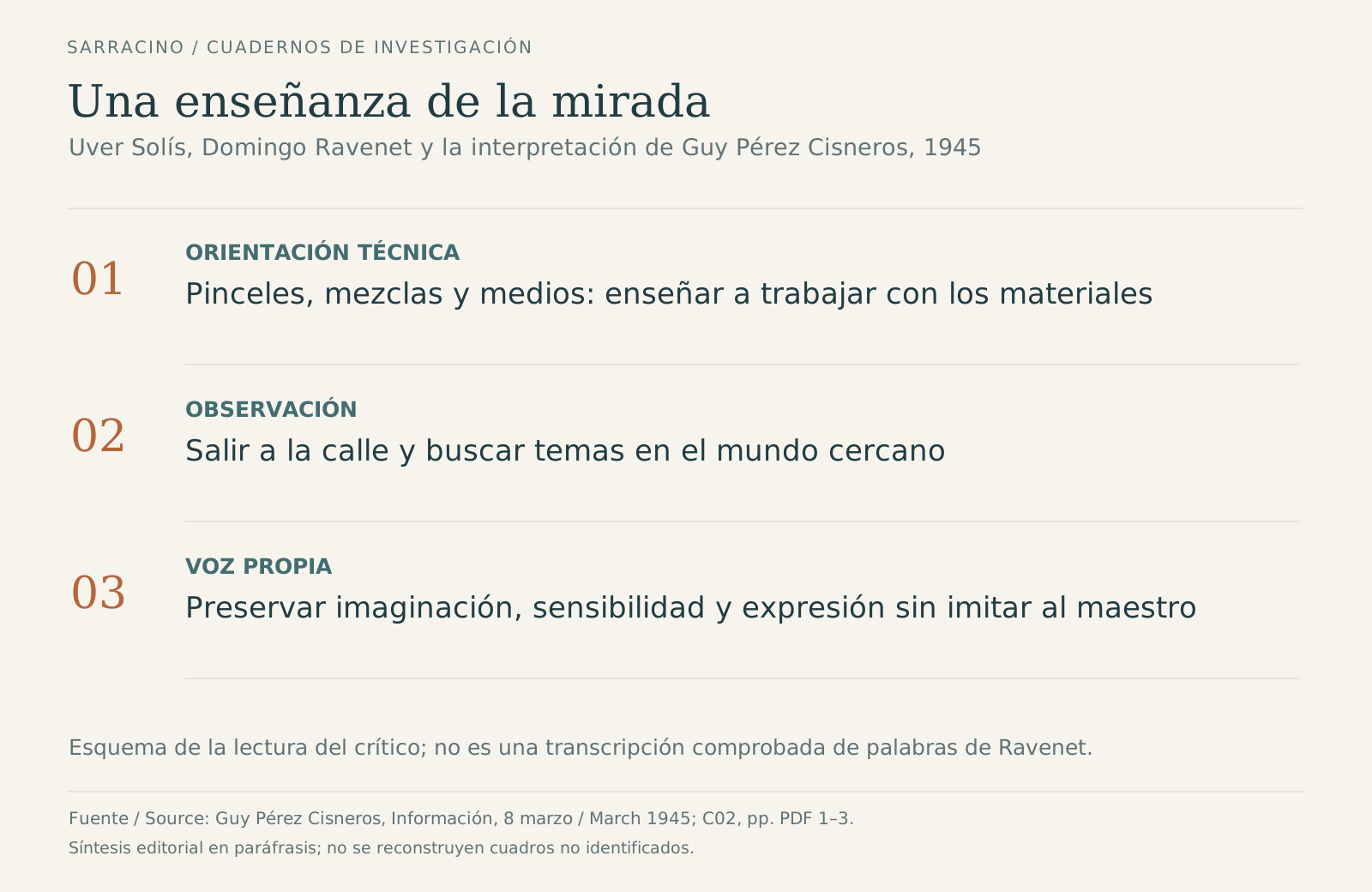
Dentro de esa polémica, el maestro tiene tareas muy precisas. Orienta sobre pinceles y mezclas de colores; advierte acerca de la fragilidad de ciertos procedimientos; estimula la observación de la calle y la búsqueda de temas. También recomienda medios y habla de otros artistas. El aprendizaje descrito incluye conocimiento material, selección y conversación. La libertad que el crítico celebra se sostiene en ese acompañamiento.
Un registro contemporáneo ayuda a situar a Ravenet sin convertir la reseña en testimonio único. El catálogo del Museum of Modern Art sobre su colección latinoamericana, publicado en 1943, lo identifica como profesor de la Escuela Normal de La Habana y director de exposiciones en la Universidad. Esa referencia confirma su actividad pedagógica e institucional, no las palabras exactas que Pérez Cisneros le adjudica. [3, p. 94]
El pasaje que pone consejos en boca de Ravenet debe leerse, por ello, como la presentación que hace el crítico de una relación de enseñanza. No conocemos por estas páginas si transcribe una conversación, condensa varias o construye una escena explicativa. Su valor está en mostrar qué espera Pérez Cisneros de un buen maestro: que intervenga en los medios de trabajo sin apropiarse del destino de la imagen.
Una dificultad convertida en procedimiento
La argumentación alcanza su punto más fértil cuando abandona las consignas y describe cómo se pinta. Pérez Cisneros relaciona la cautela de Solís ante la mezcla de las aguas con superficies densas, tonalidades oscuras y separaciones blancas entre zonas de color. Lo que podría juzgarse como una limitación técnica adquiere, en su lectura, una capacidad organizadora. El intervalo que impide mezclar también dibuja un contorno. [1, pp. 1-2]
Esta explicación permite pensar el estilo como resultado de decisiones reiteradas ante problemas materiales. La pintora no necesita ejecutar primero una norma y desviarse después de ella para producir una imagen significativa. Su manera de resolver una dificultad puede generar una estructura visual reconocible. Es una interpretación del crítico, todavía pendiente de contraste con las acuarelas expuestas, pero tiene la virtud de prestar atención al procedimiento en lugar de reducir la singularidad a un don inexplicable.
La comparación con el aguafuerte tampoco debe convertirse en identificación técnica. El artículo habla de acuarelas y gouaches; cuando evoca la estampa describe una impresión de densidad, oscuridad y definición. Confundir analogía visual con material sería perder justamente aquello que hace interesante su observación: un medio puede suscitar efectos asociados a otro sin dejar de ser el que es.
La imaginación mira su entorno
El segundo núcleo de la reseña examina la autonomía de los detalles. Manos, ojos y pies parecen actuar con impulsos propios; los objetos participan del movimiento general. Pérez Cisneros acepta que ese mundo pueda parecer infantil, pero encuentra una unidad en la intensidad afectiva que lo anima. Su vocabulario de adolescencia e ingenuidad forma parte del marco interpretativo que impone a la artista, y merece leerse con la misma atención que sus elogios. [1, p. 2]
Las escenas que describe impiden entender esa ingenuidad como ausencia de observación. Aparecen espacios de sociabilidad, ceremonias, un salón de belleza y episodios de dolor. El crítico reconoce humor, ironía e indignación. En su descripción de una madre negra con un hijo blanco y de un esclavizado frente a su amo, la imagen adquiere una tensión humana que desborda lo pintoresco. Son asuntos mencionados por el artículo; sin las obras no corresponde completar sus personajes, composición o significado racial. [1, pp. 2-3]
El final del texto premia la permanencia de Solís junto a su entorno. La casa y el bohío representan, para Pérez Cisneros, una experiencia vivida que protege de la fantasía convencional. Hay una tensión reveladora en este argumento: el crítico defiende la imaginación mientras establece qué imaginación considera valiosa. Su confianza en la libertad de la artista convive con una expectativa moral sobre su relación con la realidad. Reconocerlo permite leer la reseña como una intervención situada, con intuiciones fecundas y preferencias propias.
El legado más productivo de estas páginas es una pregunta para cualquier enseñanza artística: ¿cómo acompañar el desarrollo de alguien sin decidir de antemano qué aspecto tendrá su obra? La respuesta que Pérez Cisneros ensaya en 1945 pasa por la técnica, la observación y el respeto a soluciones que aún no se ajustan a un modelo prestigioso. Uver Solís aparece así como autora de decisiones, incluso allí donde el vocabulario de su defensor insiste en llamarlas ignorancia. Su obra merece ser buscada y examinada desde esa agencia, más allá del elogio que contribuyó a hacerla visible.
La orientación técnica, la observación y la voz propia en la lectura de Pérez Cisneros sobre Uver Solís. Síntesis editorial del artículo de 1945.
Fuentes y referencias
[1] Guy Pérez Cisneros. Uver Solis en el Lyceum. Adolescencia y pintura. Información, 8 de marzo de 1945, según cabecera transmitida. pp. PDF 1-3; página del periódico no indicada. Transcripción recompuesta; periódico original pendiente de cotejo. Archivo Sarracino, documento C02.
[2] Museo Nacional de Bellas Artes de Cuba, texto reproducido por MACVAC. Solís, Uver. Sin fecha editorial completa indicada; consultado 1 de octubre de 2026. Ficha web, párrafo inicial. Ficha institucional republicada; no se cuenta como dos testimonios independientes. Fuente en línea
[3] Lincoln Kirstein / Museum of Modern Art. The Latin-American Collection of the Museum of Modern Art [La colección latinoamericana del Museum of Modern Art]. 1943. p. impresa 94, p. PDF 103, entrada Ravenet. Catálogo contemporáneo; entrada cotejada visualmente. Fuente en línea
[4] Ethelbert Cooper Gallery of African & African American Art; equipo curatorial Alejandro de la Fuente, Bárbaro Martínez-Ruiz y Cary A. García Yero. El pasado mío / My Own Past: Afrodescendant Contributions to Cuban Art [Contribuciones afrodescendientes al arte cubano], folleto. Exposición del 16 de septiembre al 21 de diciembre de 2022. p. PDF 2, imagen y pie de Muchacha con sombrilla. Referencia visual contextual; no prueba que esta obra se expusiera en el Lyceum en 1945. Fuente en línea
The clearest indication of the teaching Guy Pérez Cisneros attributes to Domingo Ravenet is an unexpected prohibition: “Do not imitate me.” The phrase appears in his review of Uver Solís at the Lyceum, dated March 8, 1945. Its interest lies in the relationship it establishes between authority and freedom. The teacher retains an active role, but the desired outcome is that the student should recognize and develop her own way of seeing. [1, p. 1; quotation translated from Spanish]
The text survives here in a recomposed transcription attributed to the newspaper Información. The Museo de Arte Contemporáneo Vicente Aguilera Cerni reproduces an entry credited to Cuba’s Museo Nacional de Bellas Artes that dates the opening of Solís’s gouache and watercolor exhibition to the same day. This agreement supports the exhibition context, although it does not replace checking the article against the original newspaper. [2]
Teaching includes choosing what not to impose
Pérez Cisneros begins by opposing the works to certain models of correctness. Perspective, anatomy, and established poses appear as a body of formulas capable of smothering a developing sensibility. His forceful criticism should not be mistaken for proof that all academic teaching has that effect. He is defending a particular experience through a deliberately broad polemic. [1, p. 1]
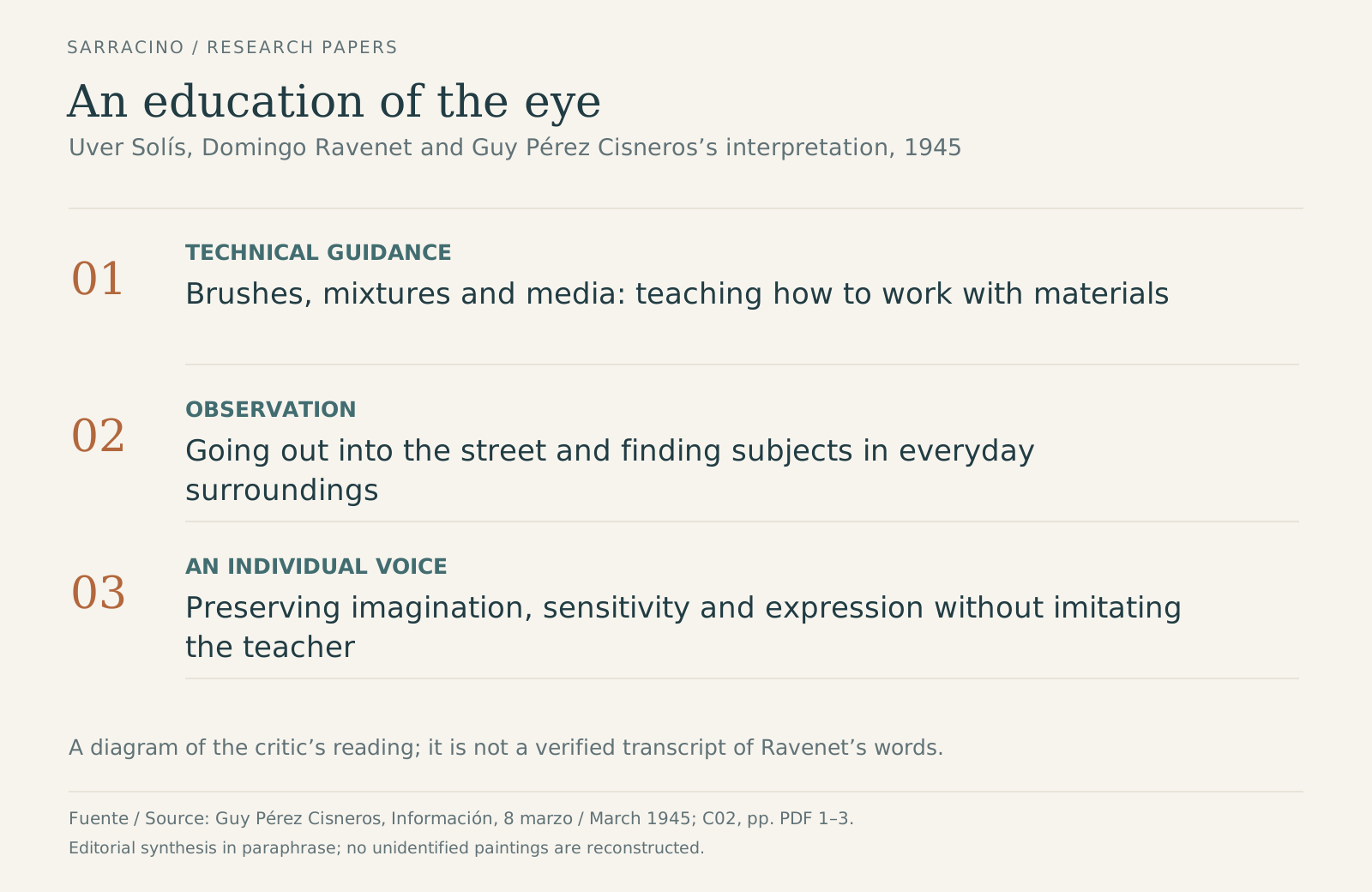
Within that polemic, the teacher has very specific tasks. He advises on brushes and color mixtures, warns about the fragility of certain procedures, and encourages observation of the street and the search for subjects. He also recommends media and discusses other artists. The learning described includes material knowledge, selection, and conversation. The freedom celebrated by the critic is sustained by this guidance.
A contemporary record helps place Ravenet without making the review our only witness. The Museum of Modern Art’s catalog of its Latin American collection, published in 1943, identifies him as a professor at Havana’s Normal School and director of exhibitions at the university. This reference confirms his educational and institutional activity, rather than the exact words Pérez Cisneros assigns to him. [3, p. 94]
The passage placing advice in Ravenet’s mouth should therefore be read as the critic’s presentation of a teaching relationship. These pages do not tell us whether he transcribes a conversation, condenses several, or constructs an explanatory scene. Its value lies in showing what Pérez Cisneros expects of a good teacher: intervention in the means of working without taking possession of the image’s eventual direction.
A difficulty turned into a procedure
The argument reaches its most fruitful point when it leaves slogans behind and describes how the painting is made. Pérez Cisneros connects Solís’s caution about watercolors running together to dense surfaces, dark tones, and white separations between areas of color. What might be judged a technical limitation acquires, in his reading, an organizing capacity. The interval that prevents mixing also draws a contour. [1, pp. 1-2]
This explanation allows us to consider style as the outcome of repeated decisions in response to material problems. The painter need not first execute a norm and then depart from it to produce a meaningful image. Her way of resolving a difficulty can generate a recognizable visual structure. This is the critic’s interpretation, still requiring comparison with the exhibited watercolors, but it has the virtue of attending to procedure rather than reducing individuality to an inexplicable gift.
Nor should the comparison with etching become an identification of technique. The article discusses watercolors and gouaches; when it evokes a print, it describes an impression of density, darkness, and definition. Confusing visual analogy with material would lose precisely what makes his observation interesting: one medium can produce effects associated with another while remaining itself.
Imagination observes its surroundings
The review’s second core examines the autonomy of details. Hands, eyes, and feet seem to act on their own impulses; objects participate in the overall movement. Pérez Cisneros accepts that this world might appear childlike, but finds a unity in the emotional intensity animating it. His vocabulary of adolescence and innocence forms part of the interpretive framework he imposes on the artist and deserves the same attention as his praise. [1, p. 2]
The scenes he describes prevent us from understanding that innocence as a lack of observation. They include places of social encounter, ceremonies, a beauty parlor, and episodes of pain. The critic recognizes humor, irony, and indignation. In his description of a Black mother with a white child and an enslaved person confronting his master, the image acquires a human tension exceeding the picturesque. These subjects are mentioned in the article; without the works, we should not supply additional characters, compositional details, or racial meanings. [1, pp. 2-3]
The text’s conclusion praises Solís for remaining close to her surroundings. For Pérez Cisneros, the house and the rural bohío stand for lived experience that protects her from conventional fantasy. There is a revealing tension in this argument: the critic defends imagination while establishing which kind he values. His confidence in the artist’s freedom coexists with a moral expectation about her relationship to reality. Recognizing this allows us to read the review as a situated intervention, with fertile insights and its own preferences.
The most productive legacy of these pages is a question for any form of artistic education: how can someone’s development be supported without deciding beforehand what their work will look like? The answer Pérez Cisneros attempts in 1945 involves technique, observation, and respect for solutions that do not yet conform to a prestigious model. Uver Solís thus emerges as the author of decisions, even where her defender’s vocabulary insists on calling them ignorance. Her work deserves to be sought out and examined through that agency, beyond the praise that helped make it visible.
Technical guidance, observation and an individual voice in Pérez Cisneros’s reading of Uver Solís. Editorial synthesis of the 1945 article.
Sources and references
[1] Guy Pérez Cisneros. Uver Solis en el Lyceum. Adolescencia y pintura. Información, March 8, 1945, according to the transmitted heading. PDF pp. 1-3; newspaper page not identified. Re-typeset transcription; the original newspaper remains to be checked. Sarracino archive, document C02.
[2] Museo Nacional de Bellas Artes de Cuba; text republished by MACVAC. Solís, Uver. No complete publication date; accessed October 1, 2026. Online artist record, opening paragraph. Later institutional record; its republication is not counted as a second independent source. Online source
[3] Lincoln Kirstein / Museum of Modern Art. The Latin-American Collection of the Museum of Modern Art [La colección latinoamericana del Museum of Modern Art]. 1943. Printed p. 94; PDF p. 103, Ravenet entry. Contemporary institutional catalogue; the entry was visually verified. Online source
[4] Ethelbert Cooper Gallery of African & African American Art; curatorial team Alejandro de la Fuente, Bárbaro Martínez-Ruiz and Cary A. García Yero. El pasado mío / My Own Past: Afrodescendant Contributions to Cuban Art [Contribuciones afrodescendientes al arte cubano], folleto. Exhibition, September 16-December 21, 2022. PDF p. 2, image and caption of Muchacha con sombrilla. Contextual visual reference; it does not establish that this work appeared at the Lyceum in 1945. Online source
Los enlaces externos se abren en otra pestaña. Para volver, cierra esa pestaña o selecciona la de Sarracino Gallery.External links open in a new tab. To return, close that tab or select the Sarracino Gallery tab.