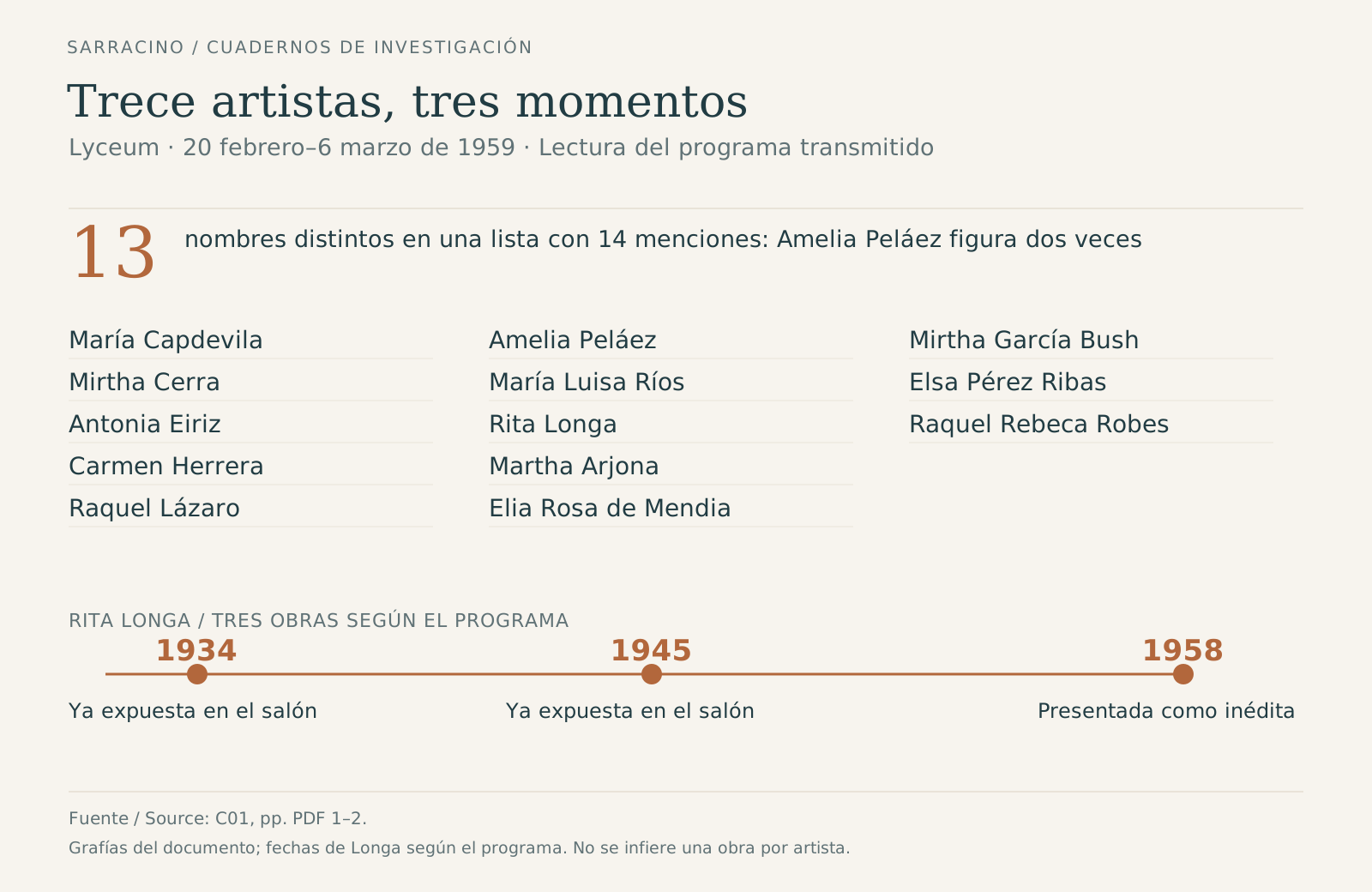
Amelia Peláez aparece dos veces en el programa de 13 artistas cubanas: entre las pintoras y entre las ceramistas. Esa repetición ayuda a entender la exposición anunciada en el Lyceum del 20 de febrero al 6 de marzo de 1959. Las disciplinas organizaban la presentación, pero no encerraban a cada artista en una sola práctica. La muestra proponía un encuentro entre medios y trayectorias que una historia centrada exclusivamente en la pintura deja fuera de campo. [1, pp. 1-2]
La portada relaciona 1929 con 1959 y sitúa la reunión dentro de una memoria institucional de treinta años. La fuente recuperada es una recomposición tipográfica del programa, no un facsímil acreditado del impreso de época. Permite estudiar el contenido transmitido, sin atribuir a 1959 su diseño actual. Tampoco debe confundirse esta muestra del Lyceum con el encuentro del Woman’s Club de ese mismo año: aquí la pregunta central es cómo una institución reunió y presentó el trabajo de trece mujeres a través de tres medios.
Un nombre que cruza las clasificaciones
Bajo pintura figuran María Capdevila, Mirtha Cerra, Antonia Eiriz, Carmen Herrera, Raquel Lázaro, Amelia Peláez y María Luisa Ríos. La página reserva un espacio singular a Rita Longa y añade los nombres de Martha Arjona, Elia Rosa de Mendia, Mirtha García Bush, Elsa Pérez Ribas y Raquel Rebeca Robes, además de repetir a Peláez. Son las grafías transmitidas por el documento; algunas requieren cotejo con el programa original. La presencia conjunta acredita una selección expositiva, no una comunidad de estilo ni una adhesión compartida a un manifiesto. [1, p. 2]
El doble registro de Peláez tiene una consecuencia crítica precisa. Si la unidad de la exposición fuese exclusivamente el medio, habría que fragmentar a la artista en dos historias. El programa, al mantener su nombre, permite seguir una autoría entre materiales. Lo pictórico y lo cerámico pasan a ser campos relacionados dentro de una trayectoria, aunque las páginas conservadas no permitan reconstruir las obras concretas ni comparar sus motivos.
La distinción importa para comprender qué concede visibilidad una exposición. El rótulo de cerámica reconoce una práctica dentro del mismo marco que pintura y escultura. Esa proximidad ofrece una oportunidad de comparación y valoración pública. No demuestra que todas las técnicas gozaran de idéntico prestigio, ni revela por sí sola cómo estaban distribuidas en la sala. Sí deja constancia de que la cerámica formaba parte expresa de la propuesta y de que las artistas vinculadas a ella merecían ser nombradas.
Rita Longa y el tiempo de una institución
La entrada de Longa introduce algo que no aparece en las demás: un relato. Según el programa, inició sus estudios de escultura en el Lyceum con Isabel Chappotín. Sus tres obras pertenecían a 1934, 1945 y 1958; las dos primeras ya habían sido exhibidas en ese salón y la última se presentaba como inédita. Conviene conservar la precisión del texto: ofrece fechas y antecedentes expositivos, pero no títulos, materiales ni dimensiones. [1, p. 2]
La selección atraviesa, por tanto, distintos momentos de una carrera. El aniversario institucional adquiere una forma concreta: el lugar donde se aprendió vuelve a recibir obras antiguas junto a una reciente. La enseñanza y la exhibición aparecen enlazadas por el tiempo. Al mencionar a Chappotín, el programa conserva además la intervención de otra mujer en esa transmisión. La institución puede leerse como un espacio que forma, exhibe y recuerda.
Las piezas anteriores no son simples acompañantes de la novedad. Su retorno invita a mirar comparativamente y a situar la producción reciente dentro de un proceso. Sin imágenes no es posible afirmar qué cambió en el lenguaje escultórico de Longa. Lo que sí puede analizarse es la operación expositiva: poner a disposición del público un antes y un después. La memoria deja de ser únicamente una lista de acontecimientos y se organiza mediante la reunión de obras.
La cerámica recupera una presencia material
Una fuente museística posterior amplía el horizonte visual. En la documentación de La generación perdida del McMullen Museum, una fotografía se vincula a 13 artistas cubanas y se identifican cerámicas de Mirta García Buch y Rebeca Robés Massés. La ficha afirma que varias piezas de su vitrina contemporánea se habían mostrado juntas en 1959. Es una atribución del museo, útil para orientar el cotejo de objetos, no un sustituto del catálogo original. [2, pp. PDF 121-122]
La fotografía permite abandonar por un momento la abstracción del listado: aparecen platos y recipientes de alturas distintas, algunos elevados sobre pequeños soportes. El volumen y la superficie comparten el campo visual. Esa coexistencia ayuda a formular una pregunta que el programa abre y que las obras tendrían que responder: ¿cómo cambia una imagen cuando organiza un recipiente, se curva, gira o exige al espectador desplazarse? La documentación disponible no autoriza a identificar cada objeto por semejanza, pero sí a reconocer que la cerámica requiere una mirada atenta a su condición material.
Leído así, el encuentro de 1959 propone una historia más amplia de la autoría femenina. Incluye a artistas dentro de una exposición común sin borrar la diversidad de sus prácticas. En Peláez, la repetición de un nombre comunica los medios; en Longa, tres fechas comunican etapas de una trayectoria y de una institución. Recuperar esa estructura permite valorar la muestra por lo que efectivamente articula: un espacio público donde la producción, la enseñanza y la memoria de las mujeres podían verse juntas.
Nómina y fechas de las tres obras de Rita Longa según el programa transmitido de 13 artistas cubanas, Lyceum, 1959. Gráfico editorial.
Fuentes y referencias
[1] Lyceum. 13 artistas cubanas. 20 de febrero-6 de marzo de 1959, según el documento recuperado. pp. PDF 1-2. Transcripción recompuesta; no se consultó el programa impreso original. Archivo Sarracino, documento C01.
[2] McMullen Museum of Art; textos didácticos de Elizabeth Thompson Goizueta y Kate Shugert, edición de Nancy Netzer. The Lost Generation / La generación perdida: textos de sala. 2024, exposición; PDF alojado en ruta de 2025. pp. PDF 108, 121-122; fotografía examinada en p. 122. Documentación museística posterior; no es el programa de 1959. Fuente en línea
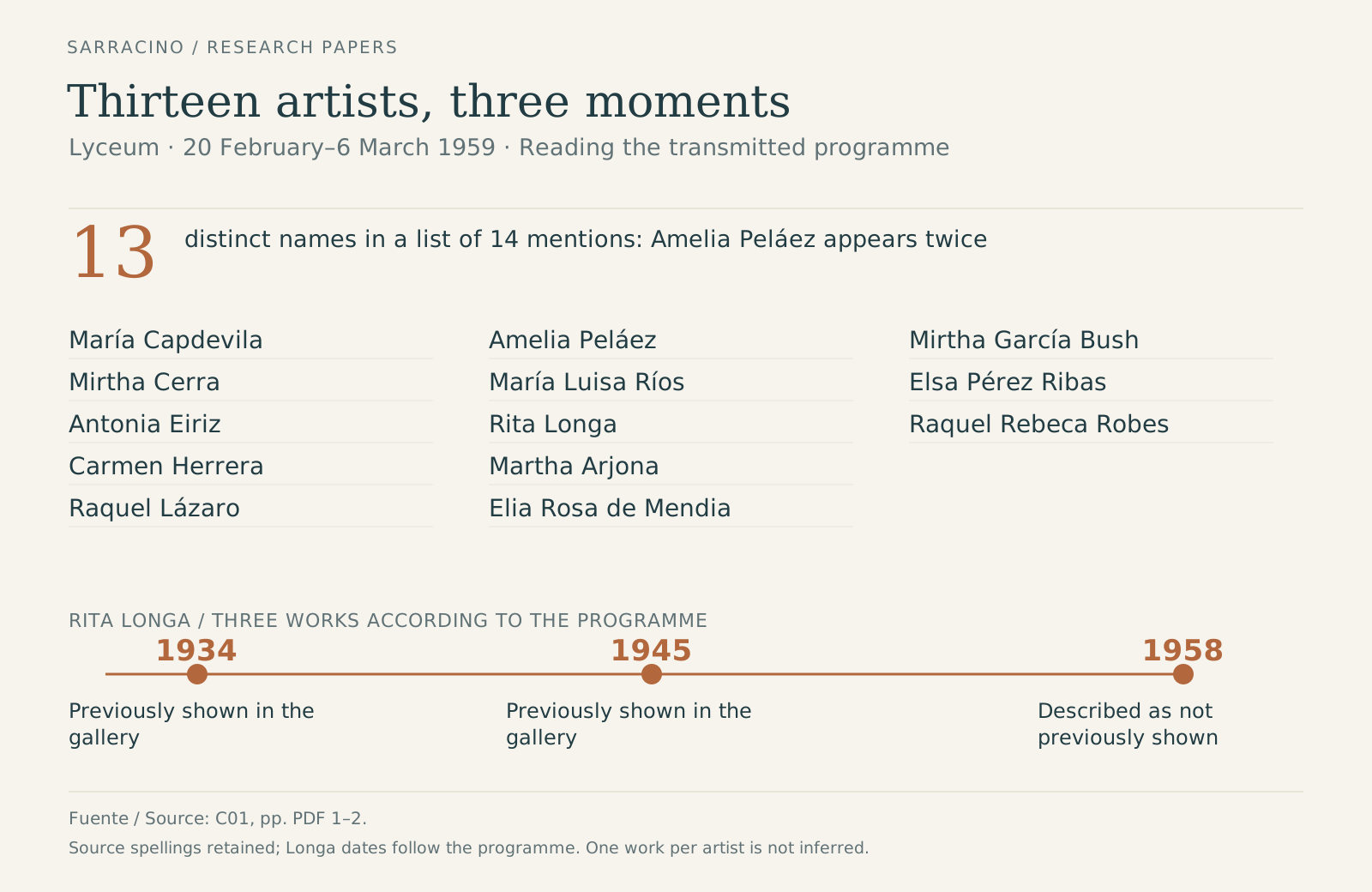
Amelia Peláez appears twice in the program for 13 artistas cubanas: among the painters and among the ceramic artists. That repetition helps explain the exhibition announced at the Lyceum from February 20 to March 6, 1959. The disciplines organized the presentation without confining each artist to a single practice. The exhibition brought together media and careers that a history focused exclusively on painting can leave outside its field of vision. [1, pp. 1-2]
The cover connects 1929 with 1959, placing the gathering within thirty years of institutional memory. The recovered source is a typographically recomposed version of the program, rather than a verified facsimile of the period publication. It allows us to study the transmitted content without assigning its present design to 1959. This Lyceum exhibition should also be distinguished from the Woman’s Club event of the same year: the central question here is how an institution brought together and presented the work of thirteen women across three media.
A name crossing classifications
The painting section lists María Capdevila, Mirtha Cerra, Antonia Eiriz, Carmen Herrera, Raquel Lázaro, Amelia Peláez, and María Luisa Ríos. The page gives Rita Longa a distinctive space and adds Martha Arjona, Elia Rosa de Mendia, Mirtha García Bush, Elsa Pérez Ribas, and Raquel Rebeca Robes, as well as listing Peláez again. These are the spellings transmitted by the document; some need checking against the original program. Their presence together records an exhibition selection, rather than a shared style or collective allegiance to a manifesto. [1, p. 2]
Peláez’s double entry has a precise critical consequence. If the exhibition’s organizing unit were exclusively the medium, the artist would have to be divided between two histories. By retaining her name, the program lets us follow an authorship across materials. Painting and ceramics become related fields within a career, although the surviving pages do not allow us to reconstruct the particular works or compare their motifs.
This distinction matters when considering what an exhibition makes visible. The ceramics heading recognizes a practice within the same framework as painting and sculpture. Their proximity offers an opportunity for comparison and public appraisal. It does not demonstrate that every technique enjoyed equal prestige, nor does it reveal how they were arranged in the gallery. It does establish that ceramics was an explicit part of the exhibition and that the artists associated with it deserved to be named.
Rita Longa and an institution’s time
Longa’s entry introduces something absent from the others: a narrative. According to the program, she began studying sculpture at the Lyceum under Isabel Chappotín. Her three works dated from 1934, 1945, and 1958; the first two had already been shown in that gallery, while the last was described as previously unexhibited. The wording should be treated precisely: it gives dates and exhibition history, but no titles, materials, or dimensions. [1, p. 2]
The selection therefore spans different moments in a career. The institutional anniversary takes concrete form: the place of learning welcomes earlier works alongside a recent one. Teaching and exhibiting are connected through time. By naming Chappotín, the program also preserves another woman’s role in that transmission. The institution can be read as a place that teaches, exhibits, and remembers.
The earlier pieces are more than companions to the new work. Their return invites comparison and places recent production within a process. Without images, we cannot establish what changed in Longa’s sculptural language. What we can analyze is the exhibition’s operation: making a before and an after available to viewers. Memory becomes more than a list of events; it is organized through the gathering of works.
Ceramics regains a material presence
A later museum source broadens the visual horizon. In the McMullen Museum’s documentation for The Lost Generation, a photograph is linked to 13 artistas cubanas, and ceramics by Mirta García Buch and Rebeca Robés Massés are identified. The label states that several objects in its contemporary display case had been shown together in 1959. This is the museum’s attribution, useful for directing an examination of the objects rather than replacing the original catalog. [2, PDF pp. 121-122]
For a moment, the photograph lets us move beyond the abstraction of a list: plates and vessels of different heights appear, some raised on small supports. Volume and surface share the visual field. Their coexistence helps formulate a question opened by the program and requiring the works themselves to answer: how does an image change when it organizes a vessel, curves, turns, or asks the viewer to move? The available documentation does not authorize identifying every object through resemblance, but it does demonstrate that ceramics calls for attention to its material condition.
Read in this way, the 1959 gathering proposes a broader history of women’s authorship. It places artists within a shared exhibition without erasing the variety of their practices. In Peláez’s case, the repetition of a name connects media; in Longa’s, three dates connect stages in an artist’s career and an institution’s history. Recovering that structure makes it possible to value the exhibition for what it actually brings together: a public space in which women’s production, teaching, and memory could be seen alongside one another.
Roster and dates of Rita Longa’s three works according to the transmitted programme for 13 Cuban Women Artists, Lyceum, 1959. Editorial diagram.
Sources and references
[1] Lyceum. 13 artistas cubanas. February 20-March 6, 1959, according to the recovered document. PDF pp. 1-2. Re-typeset transcription; the original printed program has not been consulted. Sarracino archive, document C01.
[2] McMullen Museum of Art; gallery texts by Elizabeth Thompson Goizueta and Kate Shugert, edited by Nancy Netzer. The Lost Generation / La generación perdida: textos de sala. Exhibition, 2024; PDF hosted at a 2025 URL. PDF pp. 108, 121-122; photograph on p. 122. Later museum documentation, not the original 1959 program. Online source
Los enlaces externos se abren en otra pestaña. Para volver, cierra esa pestaña o selecciona la de Sarracino Gallery.External links open in a new tab. To return, close that tab or select the Sarracino Gallery tab.