Introduction
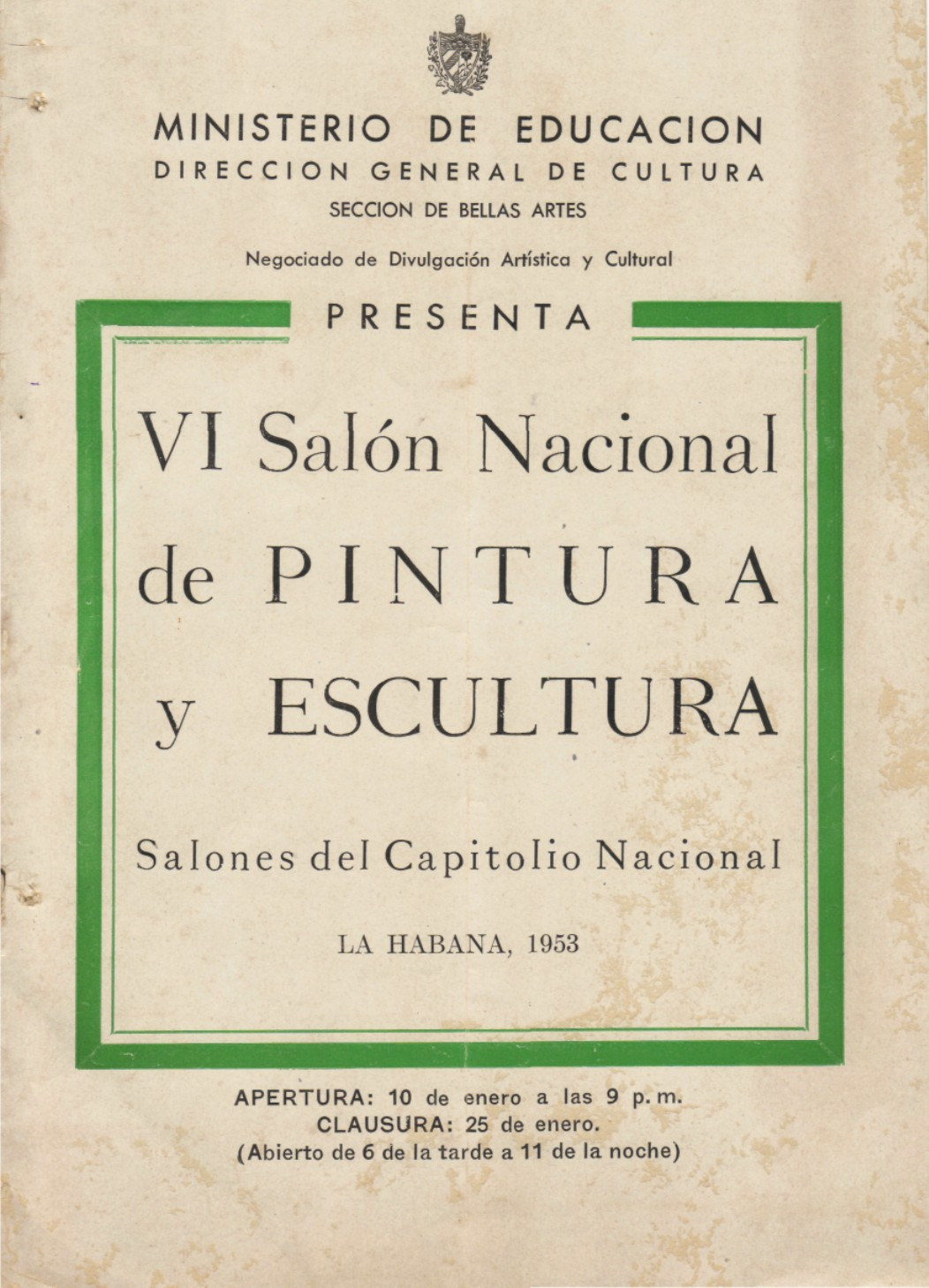
In January 1953, the halls of Havana's National Capitol hosted the VI
National Salon of Painting and Sculpture, organized by the Ministry of
Education through the General Directorate of Culture, the Fine Arts
Section, and the Office of Artistic and Cultural Dissemination. The
exhibition opened on January 10 and remained on view through January
25.
Read today, the catalogue of that exhibition has a value that extends
far beyond a simple list of artists and works. It allows us to observe,
almost in raw form, a transitional moment in Cuban art: portraiture,
landscape, religious scenes, still life, and costumbrista subjects
remain present, while languages increasingly distant from traditional
representation begin to gain visibility.
This was not a programmatically abstract exhibition, nor was it the
manifesto of a particular group. That is precisely what makes the
document so revealing. It allows us to see the Cuban artistic field of
the early 1950s before later genealogies—geometric abstraction, concrete
art, Los Once, or the international consolidation of specific
artists—retrospectively organized our understanding of the period.
A Broad and
Heterogeneous Salon
The catalogue includes both painting and sculpture and presents an
extensive roster of artists. Among the painters are Jorge Arche, Mario
Carreño, Servando Cabrera Moreno, Mirta Cerra, Hugo Consuegra, Roberto
Diago, Julio Girona, Guido Llinás, José María Mijares, René
Portocarrero, Raúl Martínez, Rafael Soriano, Zilia Sánchez, and Antonio
Vidal, among many others.
The document's importance lies precisely in this coexistence. The
same catalogue that records portraits, landscapes, and religious scenes
also includes titles such as Composition, Form, Variation No. 3, Oil No.
I, Oil No. II, and Composition of Forms.
This does not mean that every work with a formal title should
automatically be classified as abstract. The catalogue reproduces no
images and offers no formal descriptions. It does, however, show that
some artists were beginning to use a vocabulary that moved progressively
away from conventional descriptive titles.
That linguistic shift is one of the document's most revealing
signals.
Mario Carreño participated with three oils: Unexpected Encounter,
Under the Moon and the Sun, and Space in Time.
The third work is especially suggestive from a historical
perspective. Space in Time is a title that evokes questions of
structure, spatial organization, and temporality—concepts that were
becoming increasingly important within modern artistic languages of the
period.
Yet the document demands interpretive discipline. A title cannot
reconstruct a composition. We do not know what forms Carreño used, what
the works' dimensions were, or how the three paintings related to one
another.
What we can establish is more important: in January 1953 Carreño was
showing three distinctly titled works within a broad national
exhibition. That documentary fact is more valuable than any attempt to
fill the gaps through conjecture.
José
María Mijares and a Work Titled Vertical Light
José María Mijares appears with a single work: 65. Vertical Light.
Oil.
The entry is brief, but highly significant. The catalogue does not
identify the support, dimensions, or exact date of execution. We
therefore cannot state whether it was oil on canvas, panel, or another
support, nor can 1953 automatically be treated as the date of the
painting.
What we do know is that a work titled Vertical Light formed part of
the salon.
The title is significant because it introduces two concepts—light and
verticality—that may point toward a less narrative and more structural
visual organization. Yet caution is essential: without an image, any
formal reconstruction would be speculative.
For the researcher, this reference opens a concrete line of inquiry:
locating photographs of the exhibition, press archives, later
catalogues, inventories, or provenance documentation that might
eventually identify the work.
That is precisely the value of a document of this kind: it does not
complete the research, but it allows us to ask far more precise
questions.
Loló
Soldevilla: Three Sculptures Before the Image We Now Associate with
Her
One of the catalogue's most intriguing presences appears in the
sculpture section.
Loló Soldevilla is represented by three works: Mask, in bronze;
Figure, also in bronze; and Leda and the Swan, in stone.
This participation is especially important because it broadens the
view often held of Soldevilla. Historiography and the market tend to
concentrate on her later abstract and concrete production. Documents
such as this one remind us that her trajectory was more complex and that
sculpture played a significant role in her formation and
development.
The catalogue does not allow us to state what these works looked like
formally. Leda and the Swan refers to a mythological subject, while Mask
and Figure retain titles connected to the body and face.
But the material information—two bronzes and one stone
work—introduces another dimension of Soldevilla's practice: volume,
matter, mass, and three-dimensional construction.
It is precisely this complexity that is lost when an artist is
reduced to the phase for which she later became best known.
Sculpture as a
Central Part of the Salon
Sculpture was not marginal to the exhibition. Alongside Loló, the
catalogue includes, among others, Agustín Cárdenas, Roberto Estopiñán,
Florencio Gelabert, and Teodoro Ramos Blanco.
The registered materials are particularly varied: ácana wood, marble,
stainless steel, terracotta, artificial stone, direct cement, reinforced
concrete, granite, iron, and stone.
This variety reveals another aspect of artistic modernization in
Cuba: not only were forms changing, but also materials and ways of
conceiving the sculptural object.
Without installation photographs we cannot reconstruct scale or
spatial relationships. But the catalogue demonstrates that Cuban
sculpture in 1953 was actively engaged in material and formal
exploration that deserves deeper study.
One of the catalogue's most revealing features is the coexistence of
traditional titles with increasingly abstract or conceptual ones.
Guido Llinás presents Form and Interior. Salvador Corratgé appears
with Composition and Composition of Forms. Antonio Vidal presents
Composition, in gouache. Zilia Sánchez participates with Oil No. I and
Oil No. II.
These titles do not, by themselves, prove adherence to geometric
abstraction. But they do indicate a fundamental shift: the represented
subject is no longer necessarily the principal element through which the
work is identified.
In some cases, painting begins to present itself simply as painting,
form, composition, or variation.
That semantic change matters because it reveals a transformation in
the way the art object itself was being conceived.
A Moment Before
Later Classifications
From our present perspective, it is tempting to read this catalogue
retrospectively, searching for future protagonists of specific
movements.
That operation requires caution.
The 1953 salon was not an exhibition of Cuban concrete art. Nor was
it an exhibition of Los Once or any other specific group.
Its importance lies elsewhere: it documents numerous artists within
the same institutional field before later histories separated them into
clearly defined movements, generations, and tendencies.
Seen in this way, the salon offers a more complex image of Cuban art.
An artist could work simultaneously with figurative and structural
elements. Another could use an abstract title without having fully
abandoned representation. A sculptor could alternate between the figure
and material experimentation.
Actual history is usually less orderly than the classifications we
later use to understand it.
Documents, Not
Shortcuts
For collectors, researchers, and specialists, catalogues such as this
one have extraordinary value, but they also require caution.
The fact that a work is recorded in a period catalogue does not mean
that any present-day work with the same title can automatically be
identified as that object.
A solid identification requires additional evidence: photographs,
dimensions, provenance, inscriptions, archival documentation, historical
certificates, or later references.
In the case of Vertical Light, for example, we know that Mijares
presented a work with that title. We still do not know which specific
surviving work—if it survives and has been identified—corresponds to
that catalogue entry.
The same applies to Loló's bronzes.
An exhibition catalogue is one piece of a larger puzzle. Its
importance lies precisely in allowing a more rigorous investigation to
be built.
The Value of
Returning to Primary Sources
One of the problems in the study of Cuban art is that many assertions
are repeated for decades until they acquire the appearance of
certainty.
Period catalogues allow us to return to the starting point. They
allow us to verify who participated, what works were presented, how
those works were titled, and what materials were recorded.
They also allow us to identify absences. Sandú Darié and Luis
Martínez Pedro, for example, do not appear in this catalogue, although
both would later play important roles within Cuban abstraction.
Absence should not be interpreted as lack of importance. It simply
demonstrates that any single exhibition represents a particular moment,
never the totality of an artistic scene.
A
Documentary Photograph of Cuban Culture in 1953
The VI National Salon of Painting and Sculpture can be understood as
a documentary photograph of an exceptionally fertile moment.
Many elements of pictorial and sculptural tradition remain present,
but questions of form, space, structure, matter, and the autonomy of the
art object are beginning to emerge with increasing clarity.
Carreño presents Space in Time. Mijares presents Vertical Light.
Llinás presents Form. Corratgé presents Composition of Forms. Zilia
Sánchez presents works titled simply Oil No. I and Oil No. II. And Loló
Soldevilla appears still working visibly in bronze and stone.
None of these entries, taken alone, explains the development of Cuban
art.
Taken together, however, they allow us to recognize something
fundamental: the transformation was already underway.
Not uniformly, not within a single school, and not according to a
perfectly linear sequence. It was occurring simultaneously across
different artists, materials, and languages.
That is precisely why this small 1953 catalogue remains, more than
seven decades later, a source of extraordinary interest for
understanding how Cuban artistic modernity was constructed.
Research Note
This article is based on the original catalogue of the VI National
Salon of Painting and Sculpture, held in the halls of Havana's National
Capitol from January 10 to 25, 1953. The document records artists,
titles, and media, but does not reproduce the works or provide
dimensions, individual dates of execution, provenance, or award results.
Any formal interpretation should therefore be understood as a line of
inquiry rather than a substitute for original visual or archival
documentation.
Juan Sarracino
Sources consulted: Sarracino Gallery Archives.
Introducción
En enero de 1953, los salones del Capitolio Nacional de La Habana
acogieron el VI Salón Nacional de Pintura y Escultura, organizado por el
Ministerio de Educación a través de la Dirección General de Cultura, la
Sección de Bellas Artes y el Negociado de Divulgación Artística y
Cultural. La exposición abrió el 10 de enero y permaneció hasta el día
25.
Leído hoy, el catálogo de aquella exposición tiene un valor que va
mucho más allá de la simple enumeración de artistas y obras. Es un
documento que permite observar, casi en estado bruto, un momento de
transición dentro del arte cubano: conviven todavía el retrato, el
paisaje, la escena religiosa, la naturaleza muerta y el costumbrismo,
mientras comienzan a adquirir mayor visibilidad lenguajes que se
distancian de la representación tradicional.
No estamos ante una exposición programáticamente abstracta ni ante el
manifiesto de un grupo. Precisamente por eso el documento resulta tan
interesante. Permite mirar el campo artístico cubano de comienzos de los
años cincuenta antes de que ciertas genealogías posteriores —la
abstracción geométrica, el arte concreto, Los Once o la consolidación
internacional de determinados artistas— organizaran retrospectivamente
nuestra lectura del período.
Un salón amplio y
heterogéneo
El catálogo reúne pintura y escultura y presenta una nómina extensa
de artistas. Entre los pintores aparecen, entre muchos otros, Jorge
Arche, Mario Carreño, Servando Cabrera Moreno, Mirta Cerra, Hugo
Consuegra, Roberto Diago, Julio Girona, Guido Llinás, José María
Mijares, René Portocarrero, Raúl Martínez, Rafael Soriano, Zilia Sánchez
y Antonio Vidal.
La importancia del documento está precisamente en esa coexistencia.
El mismo catálogo que registra retratos, paisajes y escenas religiosas
incluye títulos como Composición, Forma, Variación No. 3, Óleo No. I,
Óleo No. II o Composición de formas.
Eso no significa que cada obra con un título de carácter formal deba
clasificarse automáticamente como abstracta. El catálogo no reproduce
imágenes y no ofrece descripciones formales. Pero sí permite comprobar
que determinados artistas estaban comenzando a utilizar un vocabulario
que se alejaba progresivamente del título descriptivo convencional.
Ese cambio de lenguaje constituye una de las señales más interesantes
del documento.
Mario Carreño participa con tres óleos: Encuentro Inesperado, Bajo la
luna y el sol y Espacio en el Tiempo.
La tercera obra resulta especialmente sugerente desde una perspectiva
histórica. Espacio en el Tiempo es un título que remite a problemas de
estructura, organización espacial y temporalidad, conceptos que
adquirieron creciente importancia dentro de los lenguajes modernos del
período.
Sin embargo, el documento obliga a mantener cierta disciplina
interpretativa. El título no permite reconstruir la composición de la
obra. No sabemos qué formas utilizó Carreño, cuáles eran sus dimensiones
ni qué relación concreta guardaba con las otras dos pinturas
presentadas.
Lo que sí podemos establecer es algo más importante: en enero de 1953
Carreño estaba mostrando tres obras de títulos claramente diferenciados
dentro de una exposición nacional de gran amplitud. Esta constatación
documental es más valiosa que cualquier intento de completar los vacíos
mediante conjeturas.
José
María Mijares y una obra llamada Luz Vertical
José María Mijares figura con una única obra: 65. Luz Vertical.
Óleo.
La entrada es breve, pero considerablemente importante. El catálogo
no identifica soporte, dimensiones ni fecha exacta de ejecución. Por
tanto, no podemos afirmar si se trataba de un óleo sobre lienzo, tabla o
cualquier otro soporte. Tampoco podemos considerar 1953 como fecha de
realización de la obra.
Pero sí sabemos que una obra titulada Luz Vertical formó parte del
salón.
El título resulta significativo porque introduce dos conceptos —luz y
verticalidad— que pueden remitir a una organización visual menos
narrativa y más estructural. No obstante, es importante no
sobreinterpretar: sin imagen, cualquier reconstrucción formal sería
especulativa.
Para el investigador, esta referencia abre una línea concreta:
localizar fotografías de la exposición, archivos de prensa, catálogos
posteriores, inventarios o documentación de procedencia que permitan
eventualmente identificar la obra.
Ese es precisamente el valor de un documento de este tipo: no
resuelve la investigación, pero formula preguntas mucho más
precisas.
Loló
Soldevilla: tres esculturas antes de la imagen que hoy asociamos con
ella
Una de las presencias más interesantes del catálogo aparece en la
sección de escultura.
Loló Soldevilla está representada por tres obras: Máscara, en bronce;
Figura, también en bronce; y Leda y el cisne, en piedra.
Esta participación es especialmente importante porque obliga a
ampliar la visión que a menudo se tiene de Soldevilla. La historiografía
y el mercado tienden a concentrarse en su producción abstracta y
concreta posterior. Sin embargo, documentos como este recuerdan que su
trayectoria fue más compleja y que la escultura desempeñó un papel
significativo dentro de su formación y evolución.
El catálogo no nos permite afirmar cómo eran formalmente estas
piezas. Leda y el cisne remite a un asunto mitológico, mientras que
Máscara y Figura conservan denominaciones vinculadas a la representación
del cuerpo y el rostro.
Pero la información material —dos bronces y una piedra— nos introduce
en otra dimensión del trabajo de Soldevilla: volumen, materia, masa y
construcción tridimensional.
Es justamente esa complejidad la que se pierde cuando un artista se
reduce a la etapa por la cual llegó posteriormente a ser más
conocido.
La escultura
como parte central del salón
La presencia escultórica no fue marginal. Junto a Loló aparecen,
entre otros, Agustín Cárdenas, Roberto Estopiñán, Florencio Gelabert y
Teodoro Ramos Blanco.
Los materiales registrados son particularmente diversos: madera de
ácana, mármol, acero inoxidable, terracota, piedra artificial, cemento
directo, concreto reforzado, granito, hierro y piedra.
Esa variedad permite observar otro aspecto de la modernización
artística cubana: no solo cambian las formas, sino también los
materiales y las formas de concebir el objeto escultórico.
Sin fotografías de sala no podemos reconstruir su escala ni sus
relaciones espaciales. Pero el catálogo demuestra que en 1953 la
escultura cubana participaba activamente de una búsqueda material y
formal que merece ser estudiada con mayor profundidad.
Uno de los aspectos más reveladores del catálogo es la convivencia de
títulos tradicionales y otros cada vez más abstractos o
conceptuales.
Guido Llinás presenta Forma e Interior. Salvador Corratgé aparece con
Composición y Composición de formas. Antonio Vidal presenta Composición,
en gouache. Zilia Sánchez participa con Óleo No. I y Óleo No. II.
Estos títulos no prueban, por sí solos, una adhesión a la abstracción
geométrica. Pero sí indican un cambio fundamental: el asunto
representado deja de ser necesariamente el elemento principal mediante
el cual se identifica la obra.
La pintura comienza a presentarse, en algunos casos, simplemente como
pintura, forma, composición o variación.
Ese cambio semántico es importante porque revela una transformación
en la manera de pensar el objeto artístico.
Un
momento anterior a las clasificaciones posteriores
Desde nuestra perspectiva actual resulta tentador leer
retrospectivamente este catálogo buscando a los futuros protagonistas de
determinados movimientos.
Sin embargo, esa operación debe hacerse con cautela.
El salón de 1953 no fue una exposición del arte concreto cubano.
Tampoco fue una exposición de Los Once ni de ningún grupo
específico.
Su importancia es precisamente otra: documenta a numerosos artistas
en un mismo campo institucional antes de que las historias posteriores
los separaran en movimientos, generaciones o tendencias claramente
delimitadas.
Mirado así, el salón ofrece una imagen más compleja del arte cubano.
Un artista podía trabajar simultáneamente con elementos figurativos y
estructurales. Otro podía utilizar un título abstracto sin haber
abandonado completamente la representación. Un escultor podía alternar
entre figura y experimentación material.
La historia real suele ser menos ordenada que las clasificaciones que
utilizamos después para comprenderla.
Documentos, no
atajos
Para coleccionistas, investigadores y especialistas, catálogos como
este tienen un valor extraordinario, pero también requieren cautela.
Que una obra aparezca registrada en un catálogo de época no significa
que cualquier obra actual con el mismo título pueda identificarse
automáticamente como aquella pieza.
Para establecer una identificación sólida hacen falta otros
elementos: fotografías, dimensiones, procedencia, inscripciones,
documentación de archivo, certificados históricos o referencias
posteriores.
En el caso de Luz Vertical, por ejemplo, sabemos que Mijares presentó
una obra con ese título. Pero todavía no sabemos qué obra concreta
conservada hoy —si existe y está identificada— corresponde a aquella
entrada.
Lo mismo ocurre con los bronces de Loló.
Un catálogo de exposición es una pieza del rompecabezas. Su
importancia reside precisamente en que permite construir una
investigación más rigurosa.
La utilidad de
volver a las fuentes
Uno de los problemas del estudio del arte cubano es que muchas
afirmaciones se repiten durante décadas hasta adquirir apariencia de
certeza.
Los catálogos de época permiten volver al punto de partida. Permiten
comprobar quién participó, qué obras presentó, cómo fueron tituladas y
qué materiales fueron registrados.
También permiten detectar ausencias. Por ejemplo, en este catálogo no
aparecen Sandú Darié ni Luis Martínez Pedro, aunque ambos desempeñarían
posteriormente papeles relevantes dentro de la abstracción cubana.
La ausencia no debe interpretarse como falta de importancia.
Simplemente demuestra que una exposición concreta representa un momento
particular y nunca la totalidad de una escena artística.
Una
fotografía documental de la cultura cubana de 1953
El VI Salón Nacional de Pintura y Escultura puede entenderse como una
fotografía documental de un momento extremadamente fértil.
Todavía están presentes numerosos elementos de la tradición pictórica
y escultórica, pero comienzan a surgir con claridad preguntas sobre
forma, espacio, estructura, materia y autonomía del objeto
artístico.
Carreño presenta Espacio en el Tiempo. Mijares presenta Luz Vertical.
Llinás presenta Forma. Corratgé presenta Composición de formas. Zilia
Sánchez presenta obras tituladas simplemente Óleo No. I y Óleo No. II. Y
Loló Soldevilla aparece todavía trabajando de manera visible con bronce
y piedra.
Ninguna de estas entradas, considerada aisladamente, explica la
evolución del arte cubano.
Pero vistas juntas permiten reconocer algo fundamental: la
transformación ya estaba ocurriendo.
No de manera uniforme, no dentro de una única escuela y no siguiendo
una secuencia perfectamente lineal. Estaba ocurriendo simultáneamente en
diferentes artistas, materiales y lenguajes.
Y precisamente por eso este pequeño catálogo de 1953 continúa siendo,
más de siete décadas después, una fuente de extraordinario interés para
comprender cómo se construyó la modernidad artística cubana.
Nota de
investigación
Este artículo está basado en el catálogo original del VI Salón
Nacional de Pintura y Escultura, celebrado en los Salones del Capitolio
Nacional de La Habana entre el 10 y el 25 de enero de 1953. El documento
registra artistas, títulos y técnicas, pero no reproduce las obras ni
proporciona dimensiones, fechas individuales de ejecución, procedencias
o resultados de premiación. Por esa razón, cualquier interpretación
formal debe entenderse como una línea de investigación y no como
sustituto de la documentación visual o archivística original.
Juan Sarracino
Fuentes consultadas: Archivos Sarracino Gallery.