El tema religioso en la pintura cubana: una exposición de Galería Cubana en 1956

Las imágenes de esta edición se han recortado y retocado para retirar sellos, etiquetas y elementos ajenos al documento. Las referencias del ensayo a las marcas materiales describen los originales de archivo. No se han reconstruido los pequeños fragmentos ocultos por las etiquetas originales.

Tema, lenguaje y memoria expositiva a partir de una invitación de época
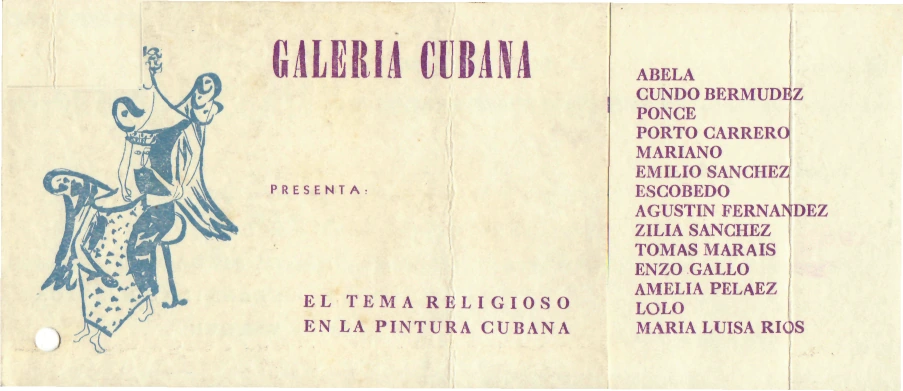
Invitación, Galería Cubana, 1956

Primera cara de la invitación: título, ilustración y artistas anunciados. Galería Cubana, 1956. Reproducción del documento aportado; se conservan sus marcas visibles.

Una invitación de marzo de 1956 reúne catorce nombres bajo un asunto común. Su lectura permite interrogar la relación entre religión, pintura y exposición, sin confundir el tema de una muestra con el estilo o las creencias de sus autores.

La historia de una exposición no se conserva únicamente en las obras que llegaron a mostrarse. También permanece en los documentos que anunciaron su existencia: nombres elegidos, títulos, fechas, direcciones e imágenes impresas que prepararon una determinada manera de mirar. Una invitación puede contener poca información y, sin embargo, conservar una decisión intelectual importante: reunir producciones diferentes alrededor de una misma pregunta.

Ese es el interés de El tema religioso en la pintura cubana, exposición anunciada por Galería Cubana para el período comprendido entre el 23 y el 31 de marzo de 1956, con motivo de la celebración de la Semana Santa. El documento no presenta un manifiesto ni identifica una escuela artística. Propone, ante todo, un asunto desde el cual mirar la pintura. [1]

La diferencia es decisiva. Lo religioso puede nombrar un contenido, una tradición de imágenes, una experiencia o una función de la obra. Ninguna de esas posibilidades constituye, por sí sola, un estilo. Leer esta invitación exige mantener abiertas esas distinciones, en lugar de hacer coincidir automáticamente tema religioso y lenguaje tradicional.

Una invitación, no un inventario de obras

Las dos caras reproducidas cumplen funciones complementarias. La primera presenta el nombre de la galería, el título de la exposición, una ilustración y la nómina de artistas. La segunda invita a la apertura e informa del calendario, el horario y la dirección. La inauguración se anuncia para el viernes 23 de marzo a las siete de la tarde; la exposición, hasta el sábado 31, con horario de lunes a sábado de tres a siete y media. El lugar indicado es calle 10, número 152, esquina a Calzada. [1–2]

El impreso anuncia catorce nombres, pero no enumera catorce cuadros. No ofrece títulos de las piezas, técnicas, dimensiones, fechas de ejecución, propietarios ni fotografías de las obras. La nómina tampoco acredita la asistencia personal de los autores a la inauguración. Registra los nombres bajo los cuales se anunció la muestra, no todas las circunstancias de su realización.

Esta precisión modifica la investigación posible. No podemos reconstruir el conjunto de pinturas a partir de la invitación, pero sí estudiar cómo se presentó la exposición al público y qué relaciones invitaba a establecer. La fuente es escueta acerca de los objetos y mucho más explícita acerca del marco en que debían ser contemplados.

La galería como lugar de interpretación

La expresión «con motivo de la celebración de la Semana Santa» vincula explícitamente la exposición con una ocasión del calendario cristiano. No es un contexto añadido por una lectura posterior: forma parte del anuncio. Al mismo tiempo, la entidad que se presenta como convocante es Galería Cubana. El documento sitúa, por tanto, ese asunto religioso en un espacio de exposición de pintura. [1]

Conviene detenerse en ese desplazamiento de contexto, sin atribuir a las obras una procedencia que ignoramos. Una imagen exhibida en una galería puede observarse como asunto devocional, pero también como solución pictórica: cómo organiza los cuerpos, distribuye el espacio o transforma un relato en relaciones de color y forma. Se trata de posibilidades de lectura, no de descripciones de las pinturas desconocidas de esta muestra.

La decisión de reunir autores bajo un tema compartido establece un marco de comparación. Permite preguntar qué cambia de una interpretación a otra y qué permanece reconocible. En ese sentido puede

leerse como una operación curatorial, aunque el impreso no identifique a una persona responsable de la selección ni exponga sus criterios. La invitación conserva la propuesta de una lectura conjunta; no conserva la explicación completa de quien la concibió.

Catorce nombres bajo un asunto común

La nómina incluye a Abela, Cundo Bermúdez, Ponce, Porto Carrero, Mariano, Emilio Sánchez, Escobedo, Agustín Fernández, Zilia Sánchez, Tomás Marais, Enzo Gallo, Amelia Peláez, Loló y María Luisa Ríos. Se mantienen aquí las formas nominales del impreso, con acentuación normalizada y sin desarrollar los nombres que aparecen abreviados. [2]

La enumeración no divide a los autores por generaciones ni los clasifica según tendencias. Tampoco establece cuántas obras corresponden a cada uno. Su unidad visible procede del encabezamiento temático. El documento permite reconocer una reunión de nombres, no deducir una comunidad de estilo, una asociación estable o un programa compartido.

Es precisamente esa diferencia la que hace interesante la exposición. Un tema común no elimina las diferencias entre los artistas: crea una ocasión para observarlas. La pregunta fértil no sería qué doctrina plástica profesaban todos, sino de qué maneras distintas podía abordarse un mismo campo de imágenes. La invitación plantea esa posibilidad, aunque para responderla necesitemos encontrar las obras.

También importa la fórmula «en la pintura cubana». El título sitúa el tema dentro de un campo artístico; no describe una nacionalidad estilística uniforme ni acredita por sí mismo el lugar de nacimiento de todos los anunciados. Como propuesta expositiva, invita a considerar esas producciones dentro de una historia compartida. Su interés no radica en borrar las diferencias, sino en hacerlas comparecer dentro de un marco común.

Tema religioso, estilo y creencia: tres planos distintos

El título habla de «el tema religioso», no de una exposición de arte destinada al culto ni de una declaración confesional de los participantes. Esa elección de palabras merece conservarse. Representar un asunto religioso, producir una imagen para una función litúrgica y expresar una convicción personal son situaciones diferentes. El documento solo enuncia la primera como criterio de reunión; no informa de las otras dos. [1–2]

Por ello, la presencia de un artista en la lista no permite deducir sus creencias. Tampoco la mención de la Semana Santa demuestra que todas las pinturas fueran crucifixiones, escenas de la Pasión o imágenes de una devoción específica. Esos asuntos serían compatibles con la ocasión anunciada, pero no están identificados en el impreso.

La misma prudencia debe aplicarse al lenguaje pictórico. Un asunto heredado puede organizarse mediante soluciones visuales muy distintas. La oposición automática entre religión y modernidad confunde lo que una obra representa con la manera en que lo hace. Este documento invita a revisar esa oposición, pero no demuestra cuáles fueron las soluciones concretas de cada participante.

Tampoco autoriza a ampliar el contenido hacia tradiciones religiosas que no menciona. Que determinados nombres despierten asociaciones en el lector no convierte esas asociaciones en un inventario de la exposición. El punto de partida debe seguir siendo la formulación que el anuncio efectivamente ofrece.

Las trayectorias no caben en una etiqueta

La lista contiene, entre otros, los nombres de Zilia Sánchez, Amelia Peláez y María Luisa Ríos, además de la mención «Loló», sin apellido. Esta última forma debe preservarse en una transcripción documental: el vínculo con una identidad desarrollada ha de establecerse mediante documentación adicional, no añadiendo al impreso información que no contiene. [2]

Para estudiar una trayectoria, el valor de estas apariciones reside en ampliar las preguntas, no en forzar un esquema evolutivo. La participación anunciada en una exposición temática no equivale a una etapa exclusiva de producción. Un artista puede seleccionar una obra anterior, mostrar una búsqueda ocasional o aparecer representado por una pieza perteneciente a otra colección. Nada de ello queda resuelto aquí.

En consecuencia, sería improcedente hablar de un «retorno a la figuración», un «abandono de la abstracción» o una «etapa religiosa» basándose únicamente en esta nómina. Tales conclusiones necesitarían obras identificadas y una cronología. La historia expositiva agrega situaciones a una biografía artística; no debe reducirla a una secuencia de etiquetas que se sustituyen unas a otras.

La imagen impresa también construye la exposición

La primera cara del documento combina una ilustración azul de figuras aladas con tipografía violeta. El nombre de Galería Cubana ocupa la zona superior; el título de la muestra aparece separado de la columna de autores. En la segunda cara, bandas horizontales violetas organizan la información. La composición apaisada se reconoce con claridad al observar las dos reproducciones en sus proporciones originales. [2–3]

Las figuras aladas admiten una lectura angélica y establecen una afinidad visual con el tema anunciado. Su trazo esquemático y el movimiento de las siluetas aportan una interpretación gráfica, no una reproducción identificada de alguna de las pinturas. Las imágenes consultadas no ofrecen un crédito legible que permita atribuir con seguridad esa ilustración a uno de los participantes.

La invitación puede estudiarse, así, como un objeto visual con decisiones propias. No sustituye a las obras, pero participa en su presentación pública. Antes de entrar en la sala, el destinatario ya encontraba un título, un repertorio de nombres y una imagen que orientaban su expectativa. Esa primera mediación forma parte de la historia de la exposición.

Qué puede aportar a investigadores y coleccionistas

La primera aportación es una referencia documental concreta: una exposición anunciada con título, entidad convocante, fechas y nómina. La segunda es una pregunta histórica: por qué y de qué modo se reunieron esas producciones bajo el tema religioso. La tercera es un programa de búsqueda que permita pasar del anuncio al conocimiento de los objetos.

Una fotografía de sala podría establecer relaciones visuales; un inventario, identificar títulos y propietarios; una crítica, mostrar cómo fue recibida la propuesta. Son fuentes por localizar, no documentos cuya existencia pueda darse aquí por demostrada. Su búsqueda permitiría contrastar el proyecto anunciado con la exposición efectivamente realizada.

Para quien conserva una pintura relacionada con alguno de estos nombres, la coincidencia temática puede justificar una investigación, pero no una identificación automática. No bastaría con que una obra tuviera asunto religioso y una fecha compatible para afirmar que estuvo en Galería Cubana en marzo de 1956.

Habría que establecer el enlace entre ese objeto y esta exposición. La invitación abre la pesquisa; no la concluye.

Una historia que comienza antes de mirar los cuadros

El interés de este impreso no depende de convertirlo en prueba de más cosas de las que puede sostener. Su contribución específica es conservar una manera de presentar la pintura cubana: no mediante una sola firma ni mediante la declaración de una escuela, sino a través de un tema que permitía convocar a varios autores.

Leído desde ese punto de vista, El tema religioso en la pintura cubana propone una pregunta que sigue siendo útil: ¿qué ocurre cuando un asunto compartido se convierte en el espacio de encuentro de distintas prácticas pictóricas? El documento no conserva la respuesta visual, pero sí el gesto de haber planteado ese encuentro.

Investigar la modernidad artística requiere atender también a esos gestos. No solo a la aparición de un lenguaje nuevo, sino a las condiciones en que las imágenes fueron reunidas, presentadas e interpretadas. En esta invitación de 1956, el título, los nombres y la ocasión religiosa permiten comenzar esa historia. El trabajo siguiente consiste en recuperar las obras sin reemplazarlas por nuestras expectativas.

Nota documental

Este ensayo se basa exclusivamente en la reproducción digital de dos caras de la invitación de Galería Cubana. Los datos de la exposición se presentan como información anunciada por el impreso; las consideraciones sobre tema, lenguaje y presentación son interpretaciones del autor. No se han identificado las pinturas ni añadido biografías, atribuciones o reconstrucciones visuales ajenas al documento. La ciudad no se imprime en las caras consultadas. Las fechas y el horario se han comprobado visualmente, pues el texto extraído contiene errores de reconocimiento.

Referencias del documento

[1] Galería Cubana, El tema religioso en la pintura cubana, invitación, 23–31 de marzo de 1956. Segunda cara, página 2 de la reproducción digital: convocatoria, Semana Santa, fechas, horario y dirección.

[2] Ibíd., primera cara, página 1 de la reproducción digital: nombre de la galería, título, nómina de catorce autores e ilustración.

[3] Ibíd., ambas caras: disposición gráfica, tipografía, color y proporciones del documento reproducido.

Juan Sarracino

Fuentes consultadas: Archivos Sarracino Gallery.

The Religious Theme in Cuban Painting: An Exhibition at Galería Cubana in 1956

Images in this edition have been cropped and retouched to remove stamps, labels and unrelated surroundings. References in the essay to material markings describe the archival originals. Small details hidden by the original labels have not been reconstructed.

Subject, pictorial language, and exhibition history through a period invitation

Invitation, Galería Cubana, 1956

First side of the invitation: title, illustration, and announced artists. Galería Cubana, 1956. Reproduction of the supplied document; visible marks are retained.

An invitation from March 1956 brings fourteen names together around a shared subject. Reading it allows us to examine the relationship between religion, painting, and exhibition, without confusing an exhibition’s theme with its artists’ styles or beliefs.

The history of an exhibition survives not only in the works that were shown. It also remains in the documents that announced its existence: selected names, titles, dates, addresses, and printed images that prepared a particular way of looking. An invitation may contain little information yet preserve an important intellectual decision: to bring different artistic practices together around a shared question.

Such is the interest of El tema religioso en la pintura cubana (The Religious Theme in Cuban Painting), an exhibition announced by Galería Cubana for March 23–31, 1956, on the occasion of Holy Week. The document presents neither a manifesto nor an identified artistic school. Above all, it proposes a subject through which to consider painting. [1]

The distinction is decisive. The religious may designate subject matter, a tradition of images, an experience, or a function of the work. None of these possibilities constitutes a style in itself. Reading this invitation requires us to keep those distinctions open, rather than automatically equating a religious subject with a traditional pictorial language.

An Invitation, Not an Inventory of Works

The two reproduced sides serve complementary purposes. The first presents the gallery’s name, the exhibition title, an illustration, and the list of artists. The second invites the reader to the opening and gives the dates, opening hours, and address. The opening is announced for Friday, March 23, at seven in the evening; the exhibition runs through Saturday, March 31, with hours from three to seven-thirty in the afternoon, Monday through Saturday. The stated address is Calle 10, number 152, at the corner of Calzada. [1–2]

The leaflet announces fourteen names, but it does not list fourteen paintings. It gives no titles of individual works, media, dimensions, execution dates, owners, or photographs of the paintings. Nor does the list establish that the artists personally attended the opening. It records the names under which the exhibition was announced, not all the circumstances of its realization.

This distinction changes the research that can be undertaken. We cannot reconstruct the group of paintings from the invitation, but we can study how the exhibition was presented to its public and what relationships it invited viewers to consider. The source says little about the objects and considerably more about the framework in which they were to be viewed.

The Gallery as a Place of Interpretation

The phrase “on the occasion of the celebration of Holy Week” explicitly connects the exhibition to an occasion in the Christian calendar. This is not a context added by a later interpretation: it belongs to the announcement itself. At the same time, the institution presenting the exhibition is Galería Cubana. The document thus places this religious subject within a space for exhibiting painting. [1]

It is worth considering that contextual shift without assigning the works a provenance we do not know. An image exhibited in a gallery can be viewed as devotional subject matter, but also as a pictorial solution: how it organizes bodies, distributes space, or transforms a narrative into relationships of color and form. These are possibilities for interpretation, not descriptions of the unknown paintings in this exhibition.

Bringing artists together under a shared theme establishes a framework for comparison. It allows us to ask what changes from one interpretation to another and what remains recognizable. In this sense, it can

be read as a curatorial operation, although the leaflet neither identifies a person responsible for the selection nor explains its criteria. The invitation preserves the proposal for a collective reading, not the full explanation of whoever conceived it.

Fourteen Names Around a Shared Subject

The list includes Abela, Cundo Bermúdez, Ponce, Porto Carrero, Mariano, Emilio Sánchez, Escobedo, Agustín Fernández, Zilia Sánchez, Tomás Marais, Enzo Gallo, Amelia Peláez, Loló, and María Luisa Ríos. The forms printed in the document are retained here, with accents normalized and without expanding abbreviated names. [2]

The enumeration does not divide the artists by generation or classify them by artistic tendency. Nor does it establish how many works were assigned to each. Its visible unity comes from the thematic heading. The document records a gathering of names, not evidence of a common style, an enduring association, or a shared program.

That distinction is precisely what makes the exhibition interesting. A shared subject does not eliminate differences between artists: it creates an occasion for observing them. The productive question is not what pictorial doctrine they all professed, but how differently a common field of images could be approached. The invitation raises that possibility, although answering it requires us to locate the works.

The wording “in Cuban painting” also matters. The title places the theme within an artistic field; it neither describes a uniform national style nor, by itself, establishes the birthplace of everyone announced. As an exhibition proposal, it invites those works to be considered within a shared history. Its interest lies not in erasing differences, but in allowing them to appear within a common framework.

Religious Subject, Style, and Belief: Three Distinct Levels

The title refers to “the religious theme,” not to an exhibition of art intended for worship or to a confessional declaration by the participants. That choice of words deserves to be preserved. Depicting a religious subject, producing an image for a liturgical function, and expressing a personal conviction are different situations. The document identifies only the first as the principle bringing the works together; it provides no information about the other two. [1–2]

An artist’s presence in the list therefore does not establish that artist’s beliefs. Nor does the reference to Holy Week prove that every painting was a Crucifixion, a scene of the Passion, or an image connected to a particular devotion. Such subjects would be compatible with the announced occasion, but they are not identified in the leaflet.

The same care must be applied to pictorial language. An inherited subject can be organized through very different visual solutions. Automatically opposing religion and modernity confuses what a work represents with how it represents it. This document invites us to reconsider that opposition, but does not establish the particular solutions adopted by each participant.

It does not authorize us to extend the contents to religious traditions it never mentions, either. The associations certain names may evoke for a reader do not turn those associations into an inventory of the exhibition. The starting point must remain the formulation the announcement actually provides.

Artistic Trajectories Cannot Be Reduced to a Label

Among the names listed are Zilia Sánchez, Amelia Peláez, and María Luisa Ríos, as well as the entry “Loló,” without a surname. That last form should be preserved in a documentary transcription: its connection to a fully identified person must be established through additional documentation, rather than by adding information the leaflet does not contain. [2]

When studying an artistic trajectory, the value of such appearances lies in broadening the questions, not in imposing an evolutionary scheme. Announced participation in a thematic exhibition does not amount to an exclusive phase of production. An artist may select an earlier work, show an occasional line of inquiry, or be represented by a painting belonging to another collection. None of those circumstances is resolved here.

Consequently, it would be inappropriate to speak of a “return to figuration,” an “abandonment of abstraction,” or a “religious phase” on the basis of this list alone. Such conclusions would require identified works and a chronology. Exhibition history adds situations to an artistic biography; it should not reduce that biography to a succession of labels replacing one another.

The Printed Image Also Shapes the Exhibition

The first side of the document combines a blue illustration of winged figures with violet typography. Galería Cubana’s name occupies the upper area; the exhibition title is set apart from the column of artists. On the second side, horizontal violet bands organize the information. The landscape-format composition becomes clear when the two reproductions are viewed in their original proportions. [2–3]

The winged figures can be read as angelic and establish a visual affinity with the announced subject. Their schematic lines and moving silhouettes offer a graphic interpretation, not an identified reproduction of one of the paintings. The consulted images provide no legible credit that would allow the illustration to be securely attributed to a participant.

The invitation can therefore be studied as a visual object with decisions of its own. It does not replace the works, but participates in their public presentation. Before entering the gallery, the recipient already encountered a title, a set of names, and an image that shaped expectations. That initial mediation belongs to the history of the exhibition.

What It Offers Researchers and Collectors

Its first contribution is a precise documentary reference: an exhibition announced with a title, presenting institution, dates, and list of artists. Its second is a historical question: why and how were those works brought together around the religious theme? Its third is a research agenda through which the announcement might lead to knowledge of the objects.

An installation photograph might establish visual relationships; an inventory might identify titles and owners; a review might reveal how the proposal was received. These are sources to locate, not documents whose survival can be assumed here. Searching for them would make it possible to compare the announced project with the exhibition as actually realized.

For someone holding a painting related to one of these names, a thematic connection may justify research, but not an automatic identification. A religious subject and a compatible date would not be

sufficient to claim that a work was exhibited at Galería Cubana in March 1956. The connection between that object and this exhibition would have to be established. The invitation opens the inquiry; it does not conclude it.

A History That Begins Before Looking at the Paintings

The interest of this leaflet does not depend on making it prove more than it can support. Its specific contribution is to preserve a way of presenting Cuban painting: not through a single name or the declaration of a school, but through a subject capable of bringing several artists together.

Read from this perspective, The Religious Theme in Cuban Painting raises a question that remains useful: what happens when a shared subject becomes the meeting place for different pictorial practices? The document does not preserve the visual answer, but it preserves the act of proposing that encounter.

Investigating artistic modernity requires attention to such acts as well. Not only to the emergence of a new language, but also to the conditions in which images were brought together, presented, and interpreted. In this 1956 invitation, the title, names, and religious occasion allow us to begin that history. The next task is to recover the works without replacing them with our expectations.

Documentary Note

This essay is based exclusively on the digital reproduction of two sides of Galería Cubana’s invitation. Exhibition details are presented as information announced by the leaflet; the discussion of subject, pictorial language, and presentation consists of the author’s interpretations. The paintings have not been identified, and no biographies, attributions, or visual reconstructions from outside the document have been added. No city name is printed on the consulted sides. The dates and opening hours were checked visually because the extracted text contains recognition errors.

Document References

[1] Galería Cubana, El tema religioso en la pintura cubana (The Religious Theme in Cuban Painting), invitation, March 23–31, 1956. Second side, page 2 of the digital reproduction: invitation, Holy Week, dates, opening hours, and address.

[2] Ibid., first side, page 1 of the digital reproduction: gallery name, title, fourteen artists, and illustration.

[3] Ibid., both sides: graphic arrangement, typography, color, and proportions of the reproduced document.

Juan Sarracino

Sources consulted: Sarracino Gallery Archives.

WhatsAppFacebookLinkedInX