En octubre de 1987, Tomás Sánchez escribió sobre Antonia Eiriz unas palabras que trasladan la atención desde el estilo de la artista hacia la experiencia de aprender con ella. Su afirmación central es breve: «sabe enseñar a ver». El testimonio acompaña un impreso de Grabados Antonia Eiriz, vinculado al Encuentro de Grabado de noviembre de aquel año. Leído junto a la relación de obras, permite reconocer dos formas complementarias de continuidad: la que una maestra deja en la percepción de sus alumnos y la que una colección hace posible al conservar objetos concretos. [1, pp. 1-3, 6]
Sánchez recuerda una transformación que seguía actuando en el presente. Su aprendizaje abarcaba colores, texturas y formas; la gratitud procede de haber adquirido una atención más penetrante. El breve texto no describe ejercicios, programas docentes ni instrucciones técnicas. Su fuerza reside en otra escala: un artista recuerda a su maestra por la capacidad de modificar su relación con lo visible. La enseñanza aparece como una práctica que continúa después de la clase, cada vez que el antiguo alumno vuelve a mirar.
Esta diferencia importa para estudiar un magisterio sin reducirlo a la reproducción de una manera. El testimonio de Sánchez no presenta la semejanza entre las obras de ambos como medida del éxito pedagógico. Ofrece, en cambio, una experiencia individual de apertura. Cabe leer en ella una idea exigente de formación: aprender a distinguir relaciones y calidades que antes pasaban inadvertidas. Esa lectura se apoya en sus palabras, aunque no autoriza a convertir un recuerdo personal en una teoría sistemática de Eiriz.
La enseñanza en la cronología
La sección biográfica del impreso sitúa la actividad educativa en varios ámbitos. Registra asesorías en la Escuela para Instructores de Artesanía entre 1962 y 1964 y en la Escuela Nacional de Arte entre 1965 y 1969. Añade el inicio, en 1972, de un movimiento de arte popular con agrupaciones comunitarias e instructores de distintas provincias. Esta cronología, tal como la presenta el documento de 1987, ensancha el sentido de enseñar: junto a la formación especializada figura el trabajo con participantes y espacios diferentes. [1, p. 5]
El catálogo reserva así un lugar a las relaciones que acompañaron la producción artística. Sus listas de exposiciones, premios y asesorías responden a convenciones editoriales habituales, pero su coexistencia permite formular una pregunta fértil: ¿cómo se conserva la memoria de una artista cuya actividad comprende obras y experiencias de aprendizaje? El testimonio de Sánchez aporta una respuesta desde la memoria de un alumno. La última página ofrece otra desde el museo.
Diez obras y varias posibilidades del grabado
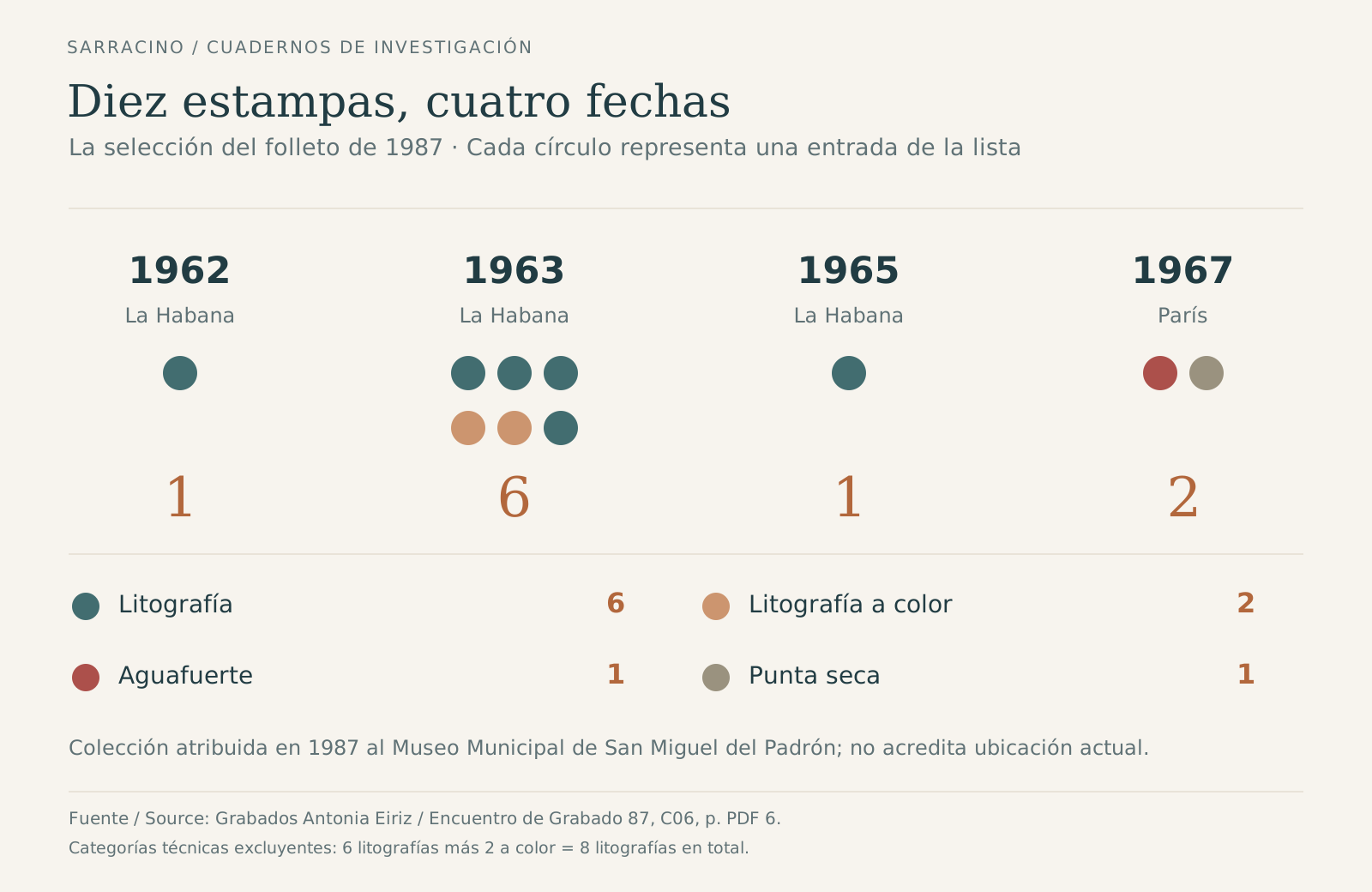
La relación final contiene diez estampas, todas consignadas como Sin título, fechadas entre 1962 y 1967. Ocho son litografías, dos de ellas a color; las restantes corresponden a un aguafuerte y una punta seca. Las litografías llevan La Habana como lugar; las dos últimas piezas, París y el año 1967. El documento da sus dimensiones en centímetros y declara que todas pertenecen a la colección del Museo Municipal de San Miguel del Padrón. Es una descripción de aquel conjunto en 1987, sin información sobre su ingreso ni sobre su localización actual. [1, p. 6]
La concentración cronológica también merece atención. Seis obras están fechadas en 1963, mientras que 1962 y 1965 tienen una cada uno; las otras dos corresponden a 1967. Esta distribución no permite medir toda la producción gráfica de Eiriz. Sí muestra la selección particular que el impreso hace accesible: un núcleo litográfico de los primeros años sesenta, acompañado por dos procedimientos de incisión sobre metal. La diversidad técnica existe dentro de un conjunto pequeño y obliga a prestar atención a diferencias que una denominación general como «grabados» puede ocultar.
Las medidas contribuyen a esa lectura material. La litografía de 1965 figura con 78 × 57 centímetros, mientras el aguafuerte de 1967 registra 31,5 × 25. Es una variación considerable de formato, aunque la lista no especifica si las medidas corresponden a la imagen o al papel. No conviene deducir composiciones a partir de esas cifras. Su valor consiste en restituir escala y técnica a objetos que comparten un título genérico. Cada entrada conserva la posibilidad de una identificación futura mediante el cotejo de las estampas y el inventario.
Una colección que permite volver a mirar
La propiedad municipal es el punto de apoyo de esta historia, pero debe distinguirse de la sede de la muestra. La Bibliografía Cubana 1987 registra Grabados, con introducción de Tomás Sánchez, en el Museo de Guanabacoa, noviembre de 1987, dentro del Encuentro de Grabado. El propio impreso menciona por separado, en la trayectoria de Eiriz, una exposición titulada 25 Grabados de Antonia Eiriz en San Miguel del Padrón. Las diez entradas finales no deben convertirse en veinticinco ni ambas referencias fundirse automáticamente en un solo acontecimiento. [2, p. 78, entrada 3106; 1, p. 4]
La distinción vuelve más interesante el conjunto. Permite pensar una memoria artística sostenida por instituciones locales y por la circulación de sus fondos, aunque el itinerario exacto requiere documentación adicional. La colección no funciona aquí como una cifra de prestigio. Su importancia está en haber reunido y registrado obras sobre papel, haciendo posible que una trayectoria pudiera ser revisitada desde sus procedimientos y sus fechas.
Hay una afinidad entre ese trabajo de conservación y el aprendizaje evocado por Sánchez. Ambos prolongan el encuentro con la obra: el primero mantiene disponibles sus testimonios materiales; el segundo conserva una manera de prestarles atención. El catálogo de 1987 permite aproximar ambas dimensiones sin confundirlas. Desde esa escala, la historia de Eiriz gana una precisión que los grandes relatos biográficos suelen perder: enseñar y conservar son actividades capaces de multiplicar las ocasiones de ver.
Nota de fuentes: las páginas citadas del impreso de 1987 corresponden al PDF conservado, que combina reproducción de portada y texto recompuesto. La ficha bibliográfica fue cotejada en la digitalización de la Biblioteca Nacional José Martí conservada por la Universidad de Florida.
Las diez estampas del catálogo
N.º
Técnica
Año
Medidas (cm)
Lugar
1
litografía
1962
38 × 31
La Habana
2
litografía
1963
39 × 32
La Habana
3
litografía
1963
39 × 53
La Habana
4
litografía
1963
52 × 47,5
La Habana
5
litografía a color
1963
35 × 43
La Habana
6
litografía a color
1963
44 × 33,5
La Habana
7
litografía
1963
57 × 45,5
La Habana
8
litografía
1965
78 × 57
La Habana
9
aguafuerte
1967
31,5 × 25
París
10
punta seca
1967
49,7 × 32,3
París
Fuente [1], p. 6 del PDF conservado. Todas las obras figuran sin título. El impreso no aclara si las medidas corresponden a la imagen o a la hoja. Numeración añadida para facilitar la lectura.
Diez entradas de la lista de estampas: distribución por fecha y técnica, según el folleto de 1987. Gráfico editorial.
Fuentes y referencias
[1] Tomás Sánchez; Dirección de Artes Plásticas y Diseño, Ministerio de Cultura; Dirección Provincial de Cultura. Grabados Antonia Eiriz / Encuentro de Grabado 87. Testimonio: octubre de 1987; portada: noviembre de 1987; imprenta: 1987. PDF 1-6, especialmente 3, 5 y 6. Copia digital, con portada reproducida e interior aparentemente recompuesto; folleto físico original no consultado. Archivo Sarracino, documento C06.
[2] Biblioteca Nacional José Martí, Departamento de Investigaciones Bibliográficas; compiladoras Elena Graupera Arango y Juana Ma. Mont Cárdenas. Bibliografía Cubana 1987, número 6, noviembre-diciembre. La Habana, 1988. p. 78, entrada 3106; PDF p. 90; portada editorial PDF p. 3. Registro bibliográfico de época cotejado visualmente; no equivale al catálogo ni al acta de inauguración. Fuente en línea
In October 1987, Tomás Sánchez wrote a few lines about Antonia Eiriz that shift attention from her style to the experience of learning from her. His central observation is brief: she “knows how to teach people to see,” translating his phrase sabe enseñar a ver. The testimony accompanies the printed booklet Grabados Antonia Eiriz, associated with the printmaking event held in November that year. Read alongside its checklist, it reveals two complementary forms of continuity: the one a teacher leaves in her students’ perception, and the one a collection makes possible by preserving particular objects. [1, pp. 1-3, 6]
Sánchez recalls a transformation still active in his present. Learning encompassed colors, textures, and forms; his gratitude arose from having acquired a more penetrating attention. The short text does not describe exercises, teaching programs, or technical instructions. Its force operates on another scale: one artist remembers his teacher for her ability to change his relationship with the visible world. Teaching emerges as a practice that continues after the lesson, whenever the former student looks again.
This distinction matters when studying an artistic teacher without reducing her influence to the reproduction of a manner. Sánchez does not offer resemblance between their works as the measure of pedagogical success. Instead, he describes an individual experience of discovery. His words suggest a demanding understanding of education: learning to distinguish relationships and qualities that previously went unnoticed. This interpretation rests on his testimony, although a personal recollection cannot establish a systematic theory of Eiriz’s teaching.
Teaching within the chronology
The booklet’s biographical section places educational activity in several settings. It records advisory work at the School for Crafts Instructors between 1962 and 1964 and at the National School of Art between 1965 and 1969. It also dates to 1972 the beginning of a popular-art movement involving community groups and instructors from different provinces. As presented in the 1987 document, this chronology broadens the meaning of teaching: specialized training appears alongside work with different participants and in other settings. [1, p. 5]
The catalogue thus makes room for the relationships that accompanied artistic production. Its lists of exhibitions, awards, and advisory activities follow familiar publishing conventions, but their coexistence raises a productive question: how is the memory of an artist preserved when her activity includes both artworks and experiences of learning? Sánchez’s testimony provides an answer through a student’s memory. The final page offers another through the museum.
Ten works and several possibilities of printmaking
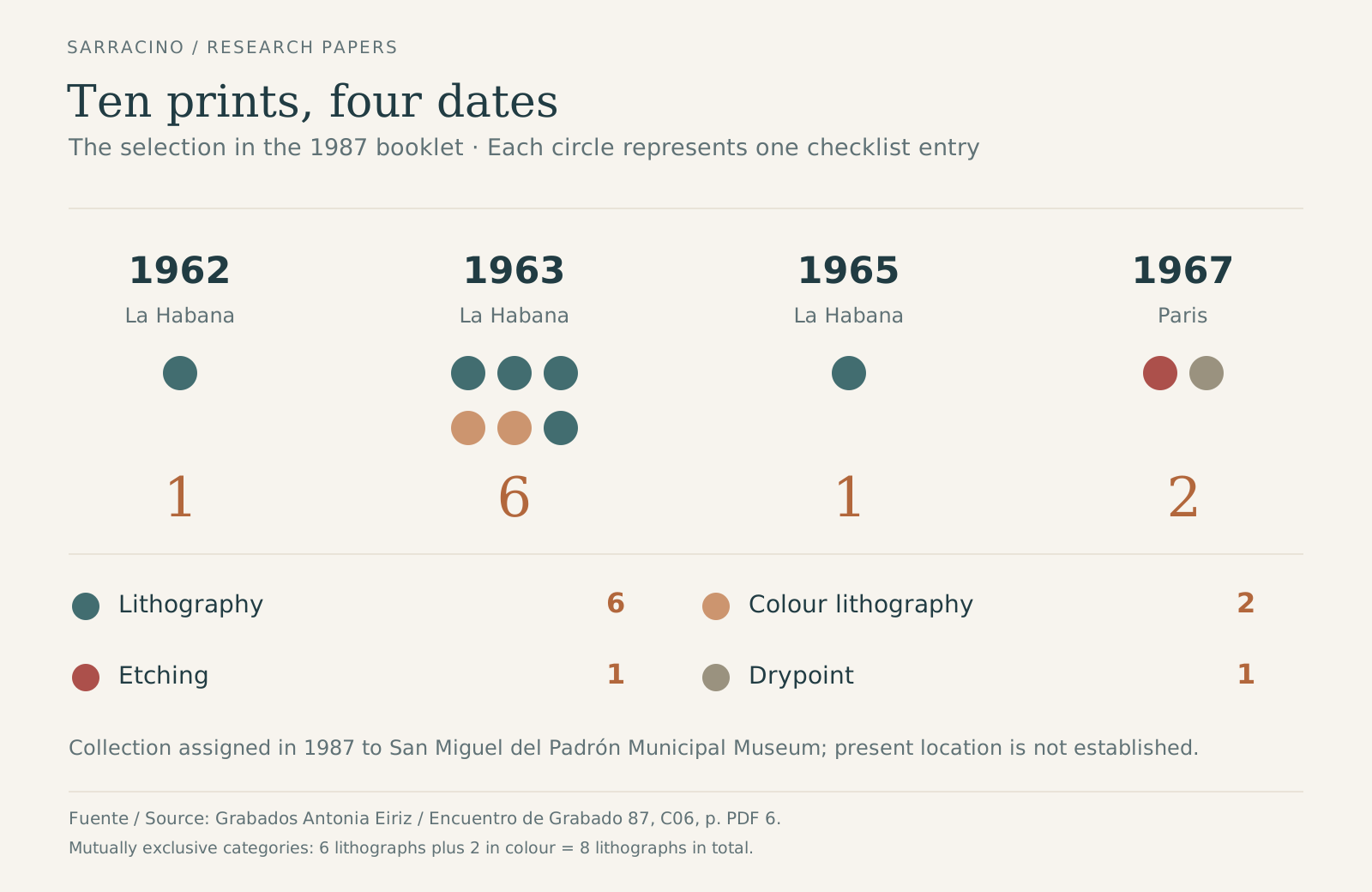
The final checklist contains ten prints, all recorded as Untitled, dated between 1962 and 1967. Eight are lithographs, including two in color; the remaining works are an etching and a drypoint. The lithograph entries give Havana as the place, while the last two entries give Paris and the year 1967. The document lists dimensions in centimeters and states that all the works belong to the collection of the Municipal Museum of San Miguel del Padrón. It describes that group in 1987, without explaining its accession history or present whereabouts. [1, p. 6]
Its chronological concentration also deserves attention. Six works are dated 1963, while 1962 and 1965 account for one each; the other two belong to 1967. This distribution cannot measure Eiriz’s entire graphic output. It does reveal the particular selection made available by the booklet: a lithographic core from the early 1960s, accompanied by two techniques involving incised metal plates. Technical variety exists within a small group and calls attention to differences that the general category of “prints” can obscure.
Dimensions contribute to this material understanding. The lithograph dated 1965 is listed at 78 × 57 centimeters, while the 1967 etching measures 31.5 × 25. The difference in format is substantial, although the checklist does not specify whether these are image or sheet dimensions. Compositions should not be inferred from those figures. Their value lies in restoring scale and technique to objects sharing a generic title. Each entry preserves the possibility of future identification through comparison with the prints and museum inventory.
A collection that makes renewed attention possible
Municipal ownership anchors this account, but it must be distinguished from the exhibition venue. The Bibliografía Cubana 1987 records Grabados, with an introduction by Tomás Sánchez, at the Museum of Guanabacoa in November 1987, as part of the printmaking event. The booklet itself separately lists, within Eiriz’s exhibition history, 25 Grabados de Antonia Eiriz at San Miguel del Padrón. Its ten final entries should not become twenty-five, nor should the two references automatically be merged into a single occasion. [2, p. 78, entry 3106; 1, p. 4]
That distinction makes the group more interesting. It allows us to consider artistic memory sustained by local institutions and the circulation of their holdings, although the precise itinerary requires further documentation. The collection’s significance here does not rest on prestige. It lies in having brought together and recorded works on paper, enabling a career to be revisited through its techniques and dates.
There is an affinity between this work of preservation and the learning recalled by Sánchez. Both extend encounters with art: preservation keeps material evidence available, while learning sustains a way of attending to it. The 1987 catalogue brings these dimensions together without collapsing their differences. At this scale, Eiriz’s history acquires a precision that broad biographical accounts often lose: teaching and collecting can multiply the opportunities to see.
Source note: page references to the 1987 booklet follow the preserved PDF, which combines a reproduced cover with re-typeset text. The bibliographic entry was checked against the digitization of the Biblioteca Nacional José Martí publication held by the University of Florida.
The ten prints in the catalogue
No.
Medium
Year
Dimensions (cm)
Place
1
lithograph
1962
38 × 31
Havana
2
lithograph
1963
39 × 32
Havana
3
lithograph
1963
39 × 53
Havana
4
lithograph
1963
52 × 47.5
Havana
5
colour lithograph
1963
35 × 43
Havana
6
colour lithograph
1963
44 × 33.5
Havana
7
lithograph
1963
57 × 45.5
Havana
8
lithograph
1965
78 × 57
Havana
9
etching
1967
31.5 × 25
Paris
10
drypoint
1967
49.7 × 32.3
Paris
Source [1], p. 6 of the preserved PDF. All works are listed as untitled. The booklet does not specify whether dimensions refer to the image or the sheet. Entry numbers have been added for ease of reference.
The ten print checklist entries, grouped by date and medium according to the 1987 booklet. Editorial chart.
Sources and references
[1] Tomás Sánchez; Dirección de Artes Plásticas y Diseño, Ministerio de Cultura; Dirección Provincial de Cultura. Grabados Antonia Eiriz / Encuentro de Grabado 87. Testimony: October 1987; cover: November 1987; printing: 1987. PDF pp. 1-6, especially 3, 5 and 6. Digital copy with reproduced cover and apparently re-typeset interior; the original physical booklet has not been examined. Sarracino archive, document C06.
[2] Biblioteca Nacional José Martí, Departamento de Investigaciones Bibliográficas; compiled by Elena Graupera Arango and Juana Ma. Mont Cárdenas. Bibliografía Cubana 1987, número 6, noviembre-diciembre. Havana, 1988. Printed p. 78, entry 3106; PDF p. 90; title page, PDF p. 3. Contemporary bibliographical record, visually checked; not an examination of the exhibition catalogue or opening records. Online source
Los enlaces externos se abren en otra pestaña. Para volver, cierra esa pestaña o selecciona la de Sarracino Gallery.External links open in a new tab. To return, close that tab or select the Sarracino Gallery tab.